Saving money in Japan: do things in the right order
Most perks in Japan depend on having something else in place first. No bank account, no credit card; no credit card, no sign-up bonus; and points from cashback sites have to be paid out to a Japanese account. This roadmap puts our guides in the order you’ll need them after arriving, and marks which guide to read at each step.
Eight things to remember
- A Japanese phone number and bank account come before everything else — get them in your first month.
- Choose a first credit card with no annual fee and easy approval, and apply for only one at a time.
- Pick one main point ecosystem and concentrate online shopping and everyday payments there so points actually add up.
- Before shopping online, applying for a card or opening an account, go through a cashback (point) site: rewards for the same offer vary a lot.
- A securities account and NISA need your My Number; furusato nozei makes sense once you have salary income.
- Free tools can help at every step: pointnavi compares cashback sites, mottoku tracks online sales, Kaitori X compares buyback prices for new items, and this site has daily deals and an event calendar.
- Child allowance, childbirth payments, student pension deferral and the medical deduction apply to foreign residents too — but you have to apply.
- After renewing your residence card, tell your bank and card issuer; when you decide to leave, work through the checklist in the last step.
- The roadmap: what to do, in order, after you arrive
- Your toolkit: four free tools
- How to use the tools, step by step
- Step 1: phone number and bank account
- Step 2: your first credit card
- Step 3: pick a main point ecosystem
- Step 4: go through a cashback site first
- Step 5: securities account, NISA and furusato nozei
- Everyday habits
- Money you shouldn’t miss: benefits and taxes
- A year of saving
- Five things foreign residents must watch
- Step 6: before you leave Japan
- FAQ
- Sources
The roadmap: what to do, in order, after you arrive
The most common detour is starting with “which card earns the most points” — then the card application fails, or points pile up with nowhere to cash them out. Japanese financial services depend on each other: card issuers check your phone number and bank account, cashback sites pay out to a Japanese account, and securities accounts need your My Number. Follow the order below and each step sets up the next.
Students who have just arrived and have no salary yet can stop at steps 1–4. Start step 5 once you earn a salary; step 6 applies whenever you leave, so bookmark it.
Your toolkit: four free tools
Each tool answers one question: this site explains how, pointnavi tells you which cashback site pays most, mottoku tells you when and where to buy, and Kaitori X tells you where to sell unused new items. All are free and need no account to browse.
① This site: May’s Money Room (5 languages)
- Daily deals: one post a day each for Amazon, Rakuten and Yahoo! Shopping with the day’s sales and campaigns you must enter first (online sales).
- Today’s deals: a live list of price drops at the three big online stores (today’s deals).
- Current campaigns: limited-time campaigns and standing perks on one page, ending soonest first (current campaigns).
- Referral codes: sign-up bonuses for cashback sites, cards, banks and payment apps, searchable by name (referral codes).
- Event calendar and event mail: festivals, markets, illuminations and weekend events by date and area, plus free email alerts for the areas and types you choose (event calendar · event mail).
- Sitemap: every English guide by category (sitemap).
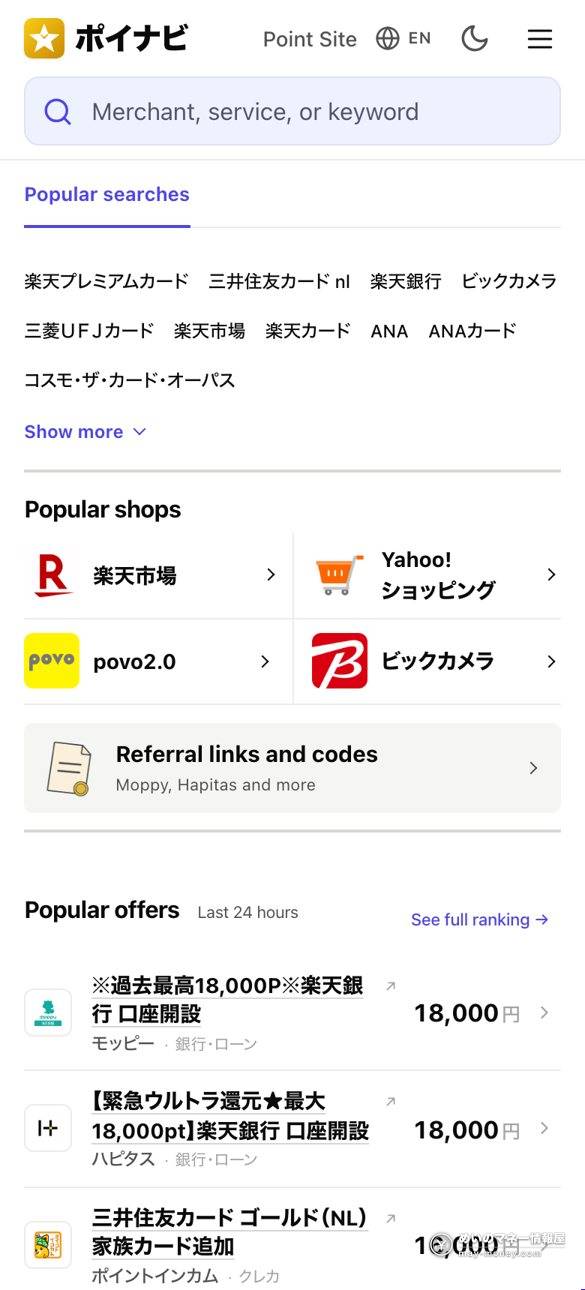
② pointnavi: compare cashback sites (5 languages)
- Checks 10 cashback sites daily — Moppy, Hapitas, Powl, Gendama, Point Income, Point Town, Rakuten Rebates, Fruit Mail, Chobirich and Warau — about 36,000 offers (November 19, 2026).
- Search an offer and every site’s reward appears side by side, converted to yen, so “10 pt = ¥1” sites are easy to compare.
- Offer pages show the 90-day high, low and trend, so you can tell whether today’s reward is high.
- Open pointnavi in English. Use it at steps 2, 4 and 5.
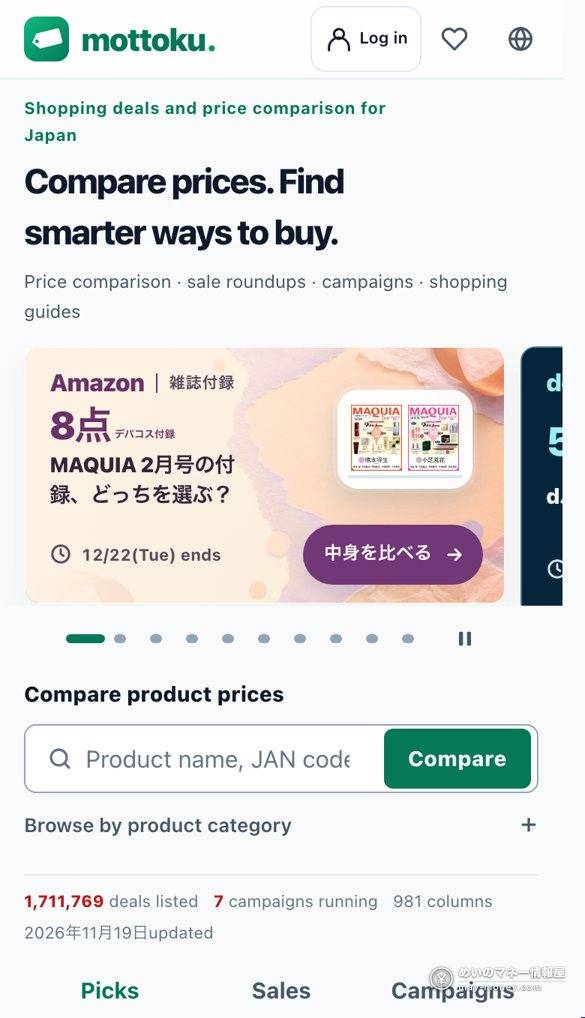
③ mottoku: online sales in one place (5 languages)
- Collects sales and point campaigns from Amazon, Rakuten and Yahoo! Shopping daily; filter by price, discount and category, or search by name, JAN code or ASIN.
- A sale calendar (Japanese) lists Rakuten Super SALE, Shopping Marathon, Rakuten’s 5-and-0 days and Yahoo!’s 5th-day events by date.
- Open mottoku in English. Use it at step 3 and for everyday shopping.
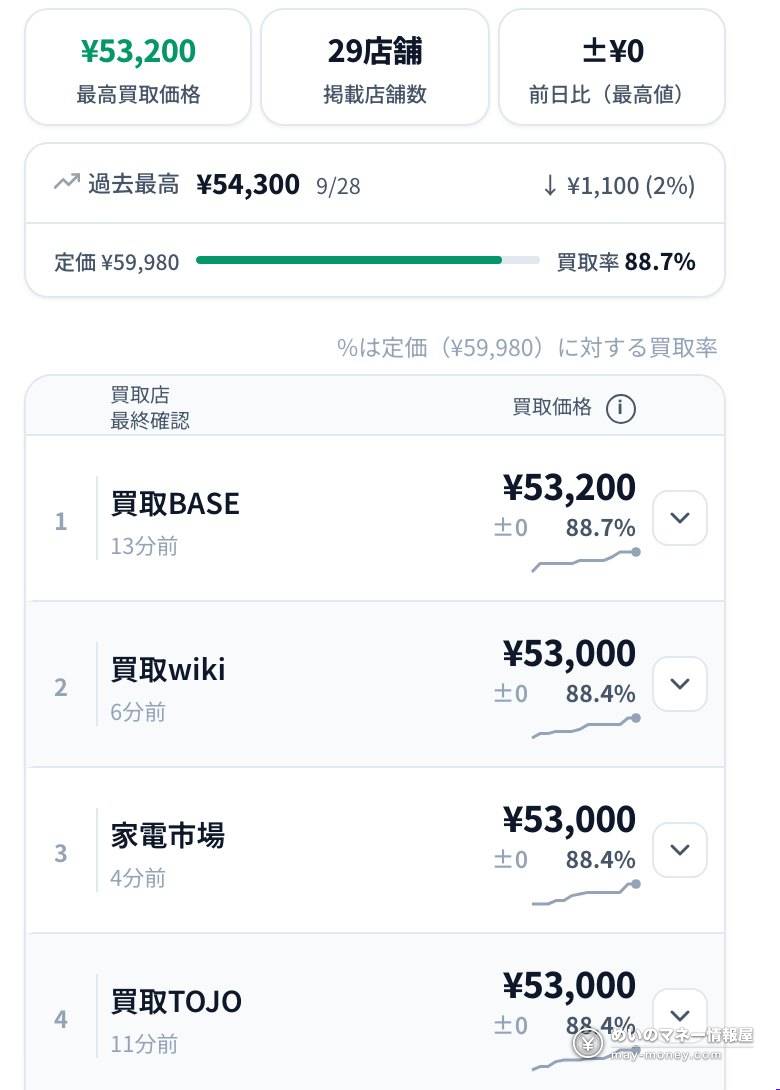
④ Kaitori X: buyback prices for new items (Japanese UI)
- Compares what 68 buyback shops pay for new, unused items, updated several times a day, with up to 180 days of price history.
- “Payout reports” show how many days real sellers waited for payment and whether the price was cut.
- A browser extension shows buyback prices on Amazon, Rakuten and other product pages (Chrome, Edge, and Safari on iPhone, iPad and Mac).
- Step-by-step: how to use Kaitori X.
| You want to… | Read first | Then use |
|---|---|---|
| Get a credit card or securities account | The guide on this site | pointnavi to find the best cashback site |
| Buy everyday items or electronics online | mottoku and its sale calendar | pointnavi for the store’s cashback |
| Catch Rakuten Marathon or Black Friday | Daily deals and the Marathon schedule | mottoku’s sale calendar |
| Find something to do this weekend | The event calendar | Event mail alerts |
| Sell new items you don’t need | Kaitori X price comparison | Kaitori X payout reports |
How to use the tools, step by step
The section above says what each tool does. This one is the order you actually click in: where to tap, which column to read and what to do next. Button names are copied from the English screens, so it is quickest to follow along with the page open.
① This site: a 10-minute weekly sweep
- Current campaignsOpen current campaigns. Tabs split them into Limited-time, Always-on, Flights, Hotels and Rail; each item shows “Ends Today”, “3 days left” or an end date, soonest first. Sign up for any campaign that requires registration here first.
- Online salesCheck online sales: each post shows whether it is running and when it ends, with the rules for Rakuten, Amazon and Yahoo! promotions.
- Before signing upSearch Referral Bonuses with “Find referral codes and bonuses by service”, or browse Point Sites, Credit Cards, Banks, Securities & Investment and more. Tap “Copy” for the code and “Guide” for the sign-up steps.
- Weekend plansIn the Event Calendar, tap Today, Tomorrow or 3-day weekend, or open Filters to set Dates, Area, Type and Conditions, then jump to the Event list. Switch to Articles for full write-ups.
- Let it come to youFor Event Emails: sign up for free and log in → pick your areas, genres and timing → press the button in the confirmation email. You get an email when a matching event appears.
② pointnavi: check before every card, account or big online order
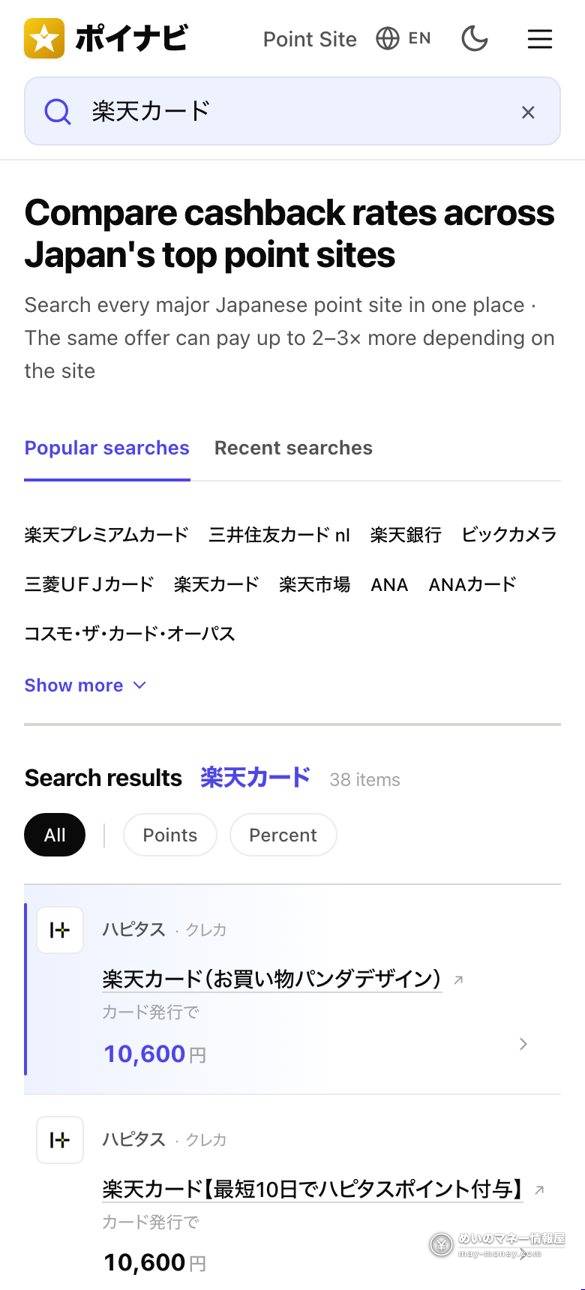
- SearchOpen pointnavi in English and type the service into Search, e.g. 楽天カード or 楽天銀行, or tap one under Popular. Offer names are in Japanese, so the Japanese name finds the most.
- Read the resultsThe list shows the number of items, and each row gives the cashback site, category, offer name, condition (e.g. カード発行で, “when the card is issued”) and the payout in yen. Use All, Points and Percent to switch between fixed and percentage offers.
- Open the offerThe detail page shows the highest and lowest payout in the past 90 days, a trend chart and a daily history. Near the 90-day high is a good time to apply; far below it, waiting can pay.
- Go through the cashback siteUse the button on the detail page to open the offer on that cashback site; if you are not a member yet, register through an invite link first. Then click through to the card or bank’s official page and finish the application in the same browser in one go; switching devices or browsers midway can lose the tracking.
- BrowseRankings shows what people applied for in the last 24 hours; Compare lines up the sites for popular services such as Rakuten Card (Japanese pages).
When does the cashback arrive?
Points usually appear as pending first and only become usable after the card or account conditions are confirmed, which can take weeks to months. Screenshot your application, and contact the cashback site if the points never confirm.
③ mottoku: when you want to buy something or wait for a sale
- StartOpen mottoku in English. The home page has four doors: Compare prices, Sale roundups, Campaigns and Shopping guides.
- You know what to buyGo to Compare and search by product name, JAN barcode number or ASIN. Narrow it down with Platform (Amazon, Rakuten Ichiba, Yahoo!, au PAY, electronics & specialty stores; several at once), Sort by (Newest, Discount rate, Recommended), Time period (last 24 hours to last month and beyond), discount rate, price and category.
- What’s on nowCampaigns lists ongoing campaigns by deadline, each with “N days left” and an end date; open one for the entry conditions.
- Sale articlesSale roundups lets you filter by mall, deadline (Before deadline, Upcoming, Ended, No deadline stated) and keyword; ended sales stay listed so you can compare with past years.
- Plan around big salesThe sale calendar (Japanese) puts the next dates of Rakuten Shopping Marathon, Super SALE, the 5-and-0 days and Yahoo!’s 5 days at the top, with a day-by-day calendar below.
Use it with pointnavi
Once mottoku tells you which store to buy from, search that store on pointnavi, see which cashback site pays most for it, and go through that site before ordering.
④ Kaitori X: three steps before you sell
- Find the itemOpen Kaitori X and search by product name or the 13-digit JAN number under the barcode (most accurate); on a phone, tap the button next to the search box to scan with the camera.
- CompareThe product page lists shops from the highest offer down, with the day-on-day change, each shop’s update time and conditions such as minimum quantities. Selling several items? Use まとめ比較 to see the total after shipping and fees.
- Pick the shopCheck 入金共有 (payout reports) for how fast others were paid and whether offers were cut, then tap 確認 on that row to apply on the shop’s site. More detail in our Kaitori X guide.
A weekly and monthly rhythm
| When | What to do |
|---|---|
| Every day | Before online shopping, compare on mottoku and check cashback on pointnavi |
| Every week | Look through Current campaigns and online sales once and enter what you need; check the event calendar before the weekend |
| Every month | Plan next month’s big sales with the mottoku calendar; check pointnavi before opening any new card or account |
| When you have something to sell | Compare on Kaitori X → read the payout reports → apply; note purchase and sale prices for your tax records |
Step 1: phone number and bank account
Once you’ve registered your address at the city office, sort out these two. Salary, rent, phone bills and card payments in Japan almost all go through automatic bank debit, and card issuers and banking apps verify you by SMS.
Bank account: the six-month line
Under the Foreign Exchange Act, foreign nationals who have been in Japan for less than six months are generally treated as non-residents, and many banks refuse or restrict accounts (people employed full-time at an office in Japan are the exception). That’s why new students usually start with Japan Post Bank; after six months you can choose any of the megabanks or online banks.
| Your situation | Open first | Notes |
|---|---|---|
| Just arrived, under 6 months (students, etc.) | Japan Post Bank (Yucho) | Its page for foreign residents doesn’t mention the six-month rule, but you need at least three months left on your stay. Students bring their student ID. |
| Full-time employee of a company in Japan | Your employer’s salary bank | Employees working at an office in Japan count as residents even in their first 6 months (part-time work doesn’t qualify). |
| Over 6 months in Japan | Any megabank or online bank | If you plan to get a credit card, use the account you use most for repayments. |
- Opening a bank account in Japan as a foreigner: which bank, what to bring, the six-month rule.
- Comparing the megabanks: MUFG vs SMBC vs Mizuho; individual guides for MUFG Bank, SMBC (Olive account) and Mizuho Bank.
- To avoid transfer fees, use Kotora: it sends up to ¥100,000 instantly to someone’s bank account with just their phone number or email address.
Phone: start cheap and easy to keep
| Plan | What it is | Good for |
|---|---|---|
| povo 2.0 | ¥0 base fee; buy data only when you need it | Mostly on Wi-Fi; just want a number for SMS |
| ahamo | docomo’s online-only plan; real conditions of the number-transfer campaign are in this guide | Heavy data users who want docomo’s network |
| Rakuten Mobile | Rakuten points when you sign up via a referral link | If Rakuten will be your main ecosystem |
Other accounts worth opening
- Dai-ichi Life NEOBANK: cashback on the debit card and a cash bonus with a referral code.
- Olive (SMBC): bank account, debit and credit in one card, in the V Point ecosystem with the SMBC Card (NL).
- JRE BANK: for regular JR East riders; meet balance and debit conditions to get Shinkansen discount coupons.
Phone first, then the card
Card issuers call or text to confirm your identity during review. The phone number and address on your application must match your residence card and resident record.
Step 2: your first credit card
Japanese card issuers look at whether you live in Japan and can repay, not at nationality. With a residence card, a registered address, a Japanese phone number and a bank account in your own name, you can apply. Three rules for the first card: no annual fee, easy approval, and only one application at a time (several applications in a short period leave a record that hurts approval).
- First credit card for foreigners and students in Japan: choosing by status, what reviewers check, what to do if rejected.
- Rakuten Card guide: students can apply, no annual fee ever.
| You are… | First-card candidates | Why |
|---|---|---|
| A student with no salary yet | Rakuten Card, AEON Card | Rakuten’s official media says students can apply; AEON says students and homemakers can apply without income. |
| An employee | SMBC Card (NL), Rakuten Card, JCB Card W | NL earns high rewards with smartphone touch payments at selected convenience stores and McDonald’s; JCB Card W is for ages 18–39. |
| On a dependent visa or a homemaker | AEON Card, a family card on your spouse’s account | No income needed; if your spouse already has a card, a family card is simplest. |
| Shopping at Marui or renting through GTN | Epos Card | GTN tenants can get the GTN Epos Card; others apply for the regular Epos Card. |
Filling in the application
Set the cash advance (キャッシング) limit to 0 and apply for shopping credit only. Apply for one card and wait for the result. If rejected, wait six months, use a debit card meanwhile, and check your record via a CIC credit report disclosure. Before applying, check pointnavi: going through a cashback site often adds points worth ¥10,000 or more.
No card yet, or rejected: debit and prepaid cards
| Card | Type | Highlights |
|---|---|---|
| Vandle Card | Visa prepaid | No review, no ID upload; register with a Japanese phone number that receives SMS and get a virtual card number instantly |
| IDARE | Prepaid | Monthly rewards on your balance by tier; no annual fee |
| OneBank | Visa prepaid + budgeting | Can pay utilities, phone bills and subscriptions |
| Olive / Dai-ichi Life NEOBANK | Debit | Paid straight from your bank balance, with cashback |
| Revolut / Wise | Multi-currency debit | Travel abroad, overseas shopping and sending money home |
Once you have some history, good second cards include the Mitsubishi UFJ Card, Amazon Prime Mastercard and AMEX Gold Preferred; hotel regulars should look at the Marriott Bonvoy AMEX. Applying through a referral link earns more than going direct:


Paying on time builds your record
CIC keeps credit information during the contract and for up to 5 years after it ends, including phone installment plans. Repay your first card on time for a while and the second is much easier to get.
Step 3: pick a main point ecosystem
A Japanese point ecosystem (keizaiken) ties one group’s credit card, QR payment, points, online store and phone plan together: the more you use within it, the higher the point rate. Spread across five or six and none adds up; pick one main ecosystem and maybe one secondary.
| Ecosystem | Card | QR payment | Points | Good for |
|---|---|---|---|---|
| Rakuten | Rakuten Card | Rakuten Pay | Rakuten Points | Rakuten Ichiba shoppers, Rakuten Mobile users |
| PayPay | PayPay Card | PayPay | PayPay Points | Yahoo! Shopping and lots of QR payments |
| V Point | SMBC Card (NL) | V Point Pay | V Point | Convenience stores, McDonald’s and other selected stores |
| d Point | d Card | d Barai | d Point | docomo and ahamo users |
| Ponta | au PAY Card | au PAY | Ponta | au users, Lawson regulars |
Then watch the regular point days
- Rakuten: Shopping Marathon (rate rises with each shop), Rakuten Super SALE and the 5-and-0 days each month. Dates: Marathon schedule · points calculator · Marathon guide.
- PayPay / Yahoo! Shopping: the 5th-day events and occasional big sales; PayPay referral code for 300 points.
- V Point: high rewards any day with smartphone touch payments at selected stores.
- d Point: home turf for docomo and ahamo users; if you borrow ChargeSPOT power banks, d Value Pass makes them free even for non-docomo users.
- Amazon: register before big sales such as Prime Day; link d Point with Amazon or order via Givearth for an extra layer of points.
- JR East: earn JRE POINT riding and shopping at stations, then trade it for a Dokokani Byuun Shinkansen round trip (JR picks the destination from 4 options).
- Drugstores: points go further at Welcia on the 20th of each month — see Wel-katsu.
Step 4: go through a cashback site first
Cashback (point) sites work simply: you click through from the site to shop, apply for a card or open an account, and part of the advertising fee comes back to you as points. A credit card or securities account through a cashback site often earns points worth thousands to tens of thousands of yen, and online shopping earns a layer on top of the store’s own points. Rewards for the same offer vary a lot, so compare first with pointnavi.
- SearchOpen pointnavi in English and search for the service or store (e.g. 楽天カード).
- CompareEvery site’s reward is shown in yen; the same card may appear with different designs or conditions, so pick the one you’ll apply for.
- Sign upOpen the top-paying site and register or log in; use a referral link below for a joining bonus.
- Apply through the linkApply via the site’s link in the same browser, in one go. Points show as pending and arrive after the site confirms.
- Cashback sites for beginners: how they work, five steps to start, turning points into money.
- pointnavi guide: comparing cashback sites offer by offer.
- Site guides: Moppy · Hapitas · Point Town · Point Income · Chobirich · Gendama · Powl · Rakuten Rebates.
- Points in spare moments: TikTok Lite and Givearth.


Anyone can join; cashing out is the key
Points end up as money in a Japanese bank account or e-wallet, so you need the bank account from step 1. Exchange routes and timing are in the beginner’s guide.
Step 5: securities account, NISA and furusato nozei
With a steady salary you can start two things that save money every year. Securities accounts and NISA need your My Number in addition to your residence card. SBI Securities requires at least 2 months left on the residence card for non-permanent residents.
- New NISA guide: up to ¥3.6 million a year (¥1.2 million tsumitate + ¥2.4 million growth), ¥18 million lifetime by purchase cost; quota frees up the year after you sell; dividends and gains inside are tax-free; one NISA account per person.
- SBI Securities account via a referral link, and getting ready for NISA.
- Furusato nozei: donate to municipalities and get everything above ¥2,000 back from next year’s resident tax and this year’s income tax, plus local gifts. Employees donating to five or fewer can use the one-stop exception (forms by January 10). From October 2025, cashback sites no longer give points for furusato nozei (rule change).
- iDeCo for foreign residents: fully deductible pension contributions, with new caps from December 2026 — but money is locked until 60.
- Going further: IPO lotteries (unsuccessful funds are returned in full), off-floor distributions, buying funds by credit card for points and shareholder perks.

Everyday habits
- Every day, one minute: check the daily deals for campaigns to enter.
- Before shopping online: compare on mottoku, check the sale calendar, then see which cashback site pays most for that store on pointnavi.
- Before the weekend: browse the event calendar for free or discounted events.
- Before selling: compare buyback prices on Kaitori X and check its payout reports.
| Situation | Guides |
|---|---|
| Trains and Shinkansen | JRE POINT · JRE CARD · Dokokani Byuun |
| Driving | ETC mileage · Times Car sharing |
| Food delivery | Delivery apps compared · Rocket Now |
| Online shopping | Amazon Prime (student half price) · Keepa · mottoku guide · GLADD |
| Drugstores, convenience stores | Wel-katsu · FamiPay · nanaco (pay taxes and pension at 7-Eleven) |
| Air miles | OneBank → ANA Pay · JAL × Marriott Bonvoy |
| Selling used items | Mercari · Rakuma; new and unused items: check Kaitori X first |
Money you shouldn’t miss: benefits and taxes
Saving isn’t only about points. Japan has payments and refunds that apply to foreign residents exactly as to Japanese citizens — but you have to claim them.
Child allowance
For anyone living in Japan and raising children up to high school age (the child must live in Japan). No income limit since October 2024: ¥15,000 a month under 3, ¥10,000 from 3 to high school age, ¥30,000 from the third child, paid in even months. Apply at your city office after a birth or move.
Childbirth lump sum
¥500,000 per birth for those in Japanese health insurance (since April 2023), usually paid straight to the hospital.
Student pension deferral
Students aged 20–59 in Japan join the National Pension; low-income students can defer premiums by applying every year.
High-cost medical care
Monthly medical costs above an income-based cap are covered by insurance; with a My Number health card you pay only up to the cap.
Medical expense deduction
Over ¥100,000 a year (or 5% of income if under ¥2 million) gets tax back through a tax return — refund-only returns can be filed within 5 years.
Year-end adjustment and tax returns
Employers settle tax in December; file a return Feb 16–Mar 15 for the medical deduction, 6+ furusato donations or side income.
- Benefits foreign residents can get: child allowance, childbirth, parental leave, sickness and unemployment.
- Japan taxes for foreign residents: year-end adjustment, tax returns and deductions for supporting family abroad.
- International students: the 28-hour rule, tax, health insurance and pension.
A year of saving
| When | What |
|---|---|
| Every month | Rakuten Shopping Marathon, Rakuten 5-and-0 days, Yahoo! 5th-day events, Wel-katsu on the 20th; child allowance in even months |
| January | New Year sales (Apple’s Hatsuuri etc.); one-stop exception forms for furusato nozei by January 10 |
| February–March | Tax returns (Feb 16–Mar 15); Rakuten Super SALE in March |
| April–May | New school year; students reapply for pension deferral |
| June | New resident tax year starts; Rakuten Super SALE |
| July | Amazon Prime Day (register first) |
| September | Rakuten Super SALE |
| November | Black Friday across Rakuten, Yahoo!, Amazon and brand stores |
| November–December | Lucky-bag (fukubukuro) lotteries and pre-orders — see the 2027 lucky bag roundup |
| December | Rakuten Super SALE; furusato nozei deadline for the year (Dec 31); year-end adjustment |
Exact dates change every year; check mottoku’s sale calendar and the daily deals.
Five things foreign residents must watch
- Tell your bank and card issuer after renewing your residence card. The Immigration Services Agency warns that if you don’t report your new period of stay, transactions may be restricted from the day after the old one expires. Report it as “applying” while your renewal is pending.
- Securities accounts and NISA need your My Number. Keep your My Number card or notice with your residence card.
- Use the name and address on your residence card and resident record. After moving, update the city office first, then your bank, cards and securities account.
- Never sell, lend or hand over your account. It’s a crime whether paid or not; Mizuho Bank notes penalties of up to 3 years in prison or a ¥5 million fine, and police warn that accounts handed over by departing foreigners are increasingly used in fraud.
- Beware calls posing as embassies or police. Anyone saying you’ll lose your status or are suspected of a crime and asking for PINs or transfers is a scammer. Hang up and check with your bank or the police.
Staying long term
Score 70 points on education, income, Japanese ability and more to apply for the Highly Skilled Professional visa, with a much faster route to permanent residency. The permanent residency guidelines are under revision — see our summary of the draft (still a draft).
Step 6: before you leave Japan
Order matters: let every debit finish before closing your bank account, and keep your phone number until last. Do it the other way round and your last card payment fails (leaving an unpaid record), and you can’t receive SMS codes from banks and cashback sites.
| When | What to do |
|---|---|
| 3 months before | Sell holdings in your securities account and NISA and move the money to your bank. NISA is generally only for residents; the exception is a company transfer abroad with a return within 5 years. SBI notes holdings may be sold by the firm if you become a non-resident without notifying them. |
| 3 months before | Resident tax: if you lived in Japan on January 1 you owe that year’s resident tax even if you leave mid-year. Employees leaving January–May have the rest deducted from their last pay; otherwise appoint a tax representative or pay in advance. |
| 1 month before | Exchange all cashback-site and other points (they pay out to a Japanese account or e-wallet), then close those accounts. |
| 1 month before | Stop new card spending, switch or cancel phone and subscription debits, and cancel the card after the last statement is paid. |
| After the last debit | Close your bank account once salary and refunds have arrived. Don’t leave it for anyone else to use. |
| Within ~2 weeks of leaving | File a moving-out notice at the city office; health insurance and National Pension end, and you’re no longer subject to resident tax from the next year. |
| Last | Cancel your phone number after everything that needs SMS is done. |
| Departure day | Return your residence card at departure immigration if leaving without a re-entry permit. |
| Within 2 years after leaving | Claim the pension lump-sum withdrawal — see the full guide. |
The lump-sum withdrawal is changing
The 2025 pension reform raises the cap from 5 to 8 years and bars claims while a re-entry permit (including special re-entry) is valid. The start date will be set by cabinet order; check the Japan Pension Service before you leave.
Planning to come back with iDeCo money? Read iDeCo for foreign residents first — withdrawals have strict conditions.
FAQ
- Q. What should I do first after arriving in Japan?
- After registering your address, get a Japanese phone number and bank account. Within six months of arrival, Japan Post Bank is the most realistic first bank.
- Q. Can students take advantage of these deals?
- Yes. Rakuten Card accepts students, and cashback sites are open to all nationalities; points are cashed out to a Japanese bank account. Start securities, NISA and furusato nozei once you have a salary.
- Q. What is a cashback (point) site?
- You click through a site to shop, apply for a card or open an account, and part of the advertising fee comes back as points you can exchange for cash or other points. Compare sites with pointnavi.
- Q. Is pointnavi available in English?
- Yes, at pointnavi.app/en, plus Japanese, Chinese, Vietnamese and Korean. Offer names stay in Japanese, so search with the Japanese or English service name.
- Q. What is Kaitori X?
- A free site comparing what 68 buyback shops pay for new, unused items, with payout reports from real sellers. The interface is Japanese; search by product name or JAN code.
- Q. Do I need to pick a point ecosystem?
- Not strictly, but one main ecosystem is easiest: card, QR payments and shopping in the same group earn higher rates and points add up in one place.
- Q. Can foreigners open a NISA account?
- Yes, if you live in Japan and have a My Number. SBI Securities requires at least 2 months left on a non-permanent resident’s card.
- Q. How do I pay online without a credit card?
- Use a debit or prepaid card that needs no review: Vandle Card with a Japanese phone number, or Olive or Dai-ichi Life NEOBANK debit cards.
- Q. Can foreigners do furusato nozei?
- Yes. It doesn’t depend on nationality; anyone paying resident and income tax in Japan can use it. Cashback sites no longer give points for it since October 2025.
- Q. Can foreigners get child allowance?
- Yes, if you live in Japan and raise children who also live in Japan. There’s no income limit since October 2024; apply at your city office.
- Q. I renewed my residence card. What else?
- Tell your bank and card issuer the new period of stay; otherwise transactions may be restricted after the old date.
- Q. When should I start preparing to leave Japan?
- About three months before: sell investments and settle resident tax first, exchange points and cancel cards a month before, close the bank after the last debit, and cancel your phone last.
- Q. Can I get my pension contributions back?
- Foreign nationals with 6+ months of contributions can claim a lump-sum withdrawal within 2 years after leaving, up to 60 months for now; the 2025 reform raises it to 8 years from a date set by cabinet order.
- Q. Can I keep my Japanese bank account after leaving?
- If you won’t return, close it yourself before leaving; many banks require it, and handing it to someone else is a crime.
Related
- Pension lump-sum withdrawal when leaving Japan
- Japan taxes for foreign residents
- Japan benefits for foreign residents
- International students in Japan
- iDeCo for foreign residents
- How to use Kaitori X
Sources
Official information below was checked on November 19, 2026. Figures for pointnavi, mottoku and Kaitori X are from each site’s public pages on the same date; detailed sources are in each linked guide.
- Immigration Services Agency: Returning your residence card
- Immigration Services Agency: Tell your bank after renewing your period of stay
- Japan Pension Service: Lump-sum withdrawal payments
- Summary of the 2025 pension reform law (lump-sum withdrawal changes, PDF)
- Sakai City: Resident tax and tax representatives for foreign residents
- Rakuten Securities: Keeping NISA when moving abroad
- SBI Securities: Procedures for non-residents
- Government of Japan: Child allowance
- National Tax Agency No.1120: Medical expense deduction
- Chiba City: Moving-out notice when leaving Japan
- Mizuho Bank: Never sell or hand over your account
- Kanagawa Prefectural Police: Accounts transferred by departing foreign residents


Get new articles by email
We will email you when a new deals article goes up. You can choose the categories, too.