Last updated: (based on Tokyo Metro’s October 29 announcement and its official sales site)
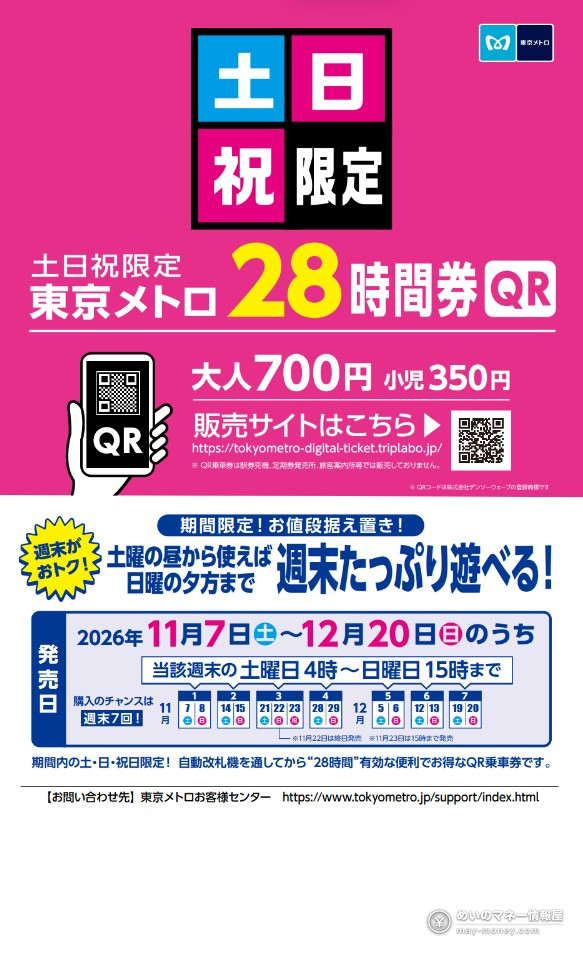
Tokyo Metro is launching a weekend-and-holiday-only 28-Hour Ticket (QR) from Saturday, November 7, 2026. It costs ¥700 for adults and ¥350 for children – exactly the same as the regular Tokyo Metro 24-Hour Ticket – but gives you four extra hours of unlimited rides on all nine Tokyo Metro lines.
The site’s front page also sells the “東京メトロ24時間券(QR)” (24-Hour Ticket) for the same ¥700. Pick the one titled “土日祝限定東京メトロ28時間券(QR)” with that weekend’s dates. Each weekend is listed as a separate ticket.
Those four hours make a real difference: start riding at noon on Saturday and the ticket lasts until 4 p.m. on Sunday, so one ticket covers a whole weekend of going out.
The catch: it is only sold on seven weekends through December 20, only on Tokyo Metro’s Japanese-language sales website, and only as a QR code on your phone. Below are the sale times, a walkthrough of the Japanese site, how many rides you need to come out ahead, and the gates where the QR code won’t scan.
- Price
- Adults ¥700 / children ¥350 (same as the 24-Hour Ticket)
- Valid for
- 28 hours from your first gate entry
- Covers
- All Tokyo Metro lines (9 lines) | not Toei Subway, JR or private railways
- Sale dates
- Seven weekends between Nov 7 and Dec 20 (including the Nov 21–23 long weekend)
- When to buy
- Saturday 4:00 a.m. to Sunday 3:00 p.m. of that weekend (no advance sales)
- First entry by
- Sunday 11:59 p.m. (Monday, Nov 23 for the long weekend)
- Where
- Tokyo Metro’s sales website only, paid by credit or debit card
Ride 4 times over the weekend (or 3 times on trips of 12 km+) and it beats paying with an IC card
- What the 28-Hour Ticket is (and how it differs from the 24-Hour Ticket)
- Seven weekends only: sale times and entry deadlines
- How many rides until it pays off?
- Which lines it covers
- Buying it on the Japanese-only site, step by step
- Eight stations where the QR code won’t scan
- Things to know before you buy
- 28-Hour vs. 24-Hour vs. other day passes
- Weekend ideas along Tokyo Metro lines
- FAQ
What the 28-Hour Ticket is (and how it differs from the 24-Hour Ticket)
Tokyo Metro already sells a 24-Hour Ticket for ¥700 that gives unlimited rides for 24 hours from your first gate entry. The new ticket is the same price with four more hours – the sales page literally describes it as “the same price as the regular 24-hour ticket, with four extra hours.”
Four hours may not sound like much, but it lets one ticket stretch across Saturday and Sunday:
- Enter at noon on Saturday → valid until 4 p.m. Sunday: shopping on Saturday afternoon, lights in the evening, and another outing on Sunday (this is the example Tokyo Metro uses)
- Enter at 5 p.m. on Saturday → valid until 9 p.m. Sunday: dinner out on Saturday, then a full day on Sunday
- Enter on Sunday evening → valid into Monday: the only rule is that your first entry must be before 11:59 p.m. on Sunday. Tokyo Metro’s own example: enter at 7:30 p.m. on Monday, November 23 (a holiday), and the ticket works until 11:30 p.m. on Tuesday, November 24
On the other hand, it is less flexible than the 24-Hour Ticket: weekends only, no advance purchase, and QR only. For weekdays, or if you want to buy ahead, the 24-Hour Ticket is still the better pick (comparison below).
Seven weekends only: sale times and entry deadlines
Each weekend is sold as a separate ticket. Sales open at 4:00 a.m. on Saturday and close at 3:00 p.m. on Sunday, and you must make your first gate entry by 11:59 p.m. on Sunday or the ticket becomes invalid. For the November 21–23 long weekend, both deadlines move to Monday, November 23.
| Weekend | On sale | First entry by |
|---|---|---|
| ① Nov 7 (Sat) – 8 (Sun) | Nov 7 4:00 a.m. – Nov 8 3:00 p.m. | Nov 8 11:59 p.m. |
| ② Nov 14 (Sat) – 15 (Sun) | Nov 14 4:00 a.m. – Nov 15 3:00 p.m. | Nov 15 11:59 p.m. |
| ③ Nov 21 (Sat) – 23 (Mon, holiday) | Nov 21 4:00 a.m. – Nov 23 3:00 p.m. | Nov 23 11:59 p.m. |
| ④ Nov 28 (Sat) – 29 (Sun) | Nov 28 4:00 a.m. – Nov 29 3:00 p.m. | Nov 29 11:59 p.m. |
| ⑤ Dec 5 (Sat) – 6 (Sun) | Dec 5 4:00 a.m. – Dec 6 3:00 p.m. | Dec 6 11:59 p.m. |
| ⑥ Dec 12 (Sat) – 13 (Sun) | Dec 12 4:00 a.m. – Dec 13 3:00 p.m. | Dec 13 11:59 p.m. |
| ⑦ Dec 19 (Sat) – 20 (Sun) | Dec 19 4:00 a.m. – Dec 20 3:00 p.m. | Dec 20 11:59 p.m. |
Note that the entry deadline is the last day of that weekend, not the day you buy: buying on Saturday and riding for the first time on Sunday is fine.
There are no advance sales, so you can’t buy it on Friday night. But if you decide on Sunday afternoon that you want to go out, you still have until 3:00 p.m. to buy it.
How many rides until it pays off?
Tokyo Metro fares are set in five distance bands. Here are the adult IC card (PASMO/Suica) fares and how many rides it takes to pass ¥700:
| Distance | Example | IC fare | Rides to pass ¥700 |
|---|---|---|---|
| 1–6 km | Ueno → Asakusa (Ginza Line) | ¥178 | 4 (¥712) |
| 7–11 km | Shibuya → Ginza (Ginza Line) | ¥209 | 4 (¥836) |
| 12–19 km | Shibuya → Asakusa (Ginza Line) | ¥252 | 3 (¥756) |
| 20–27 km | Otemachi → Nishi-Funabashi (Tozai Line) | ¥293 | 3 (¥879) |
| 28–40 km | Nakano → Nishi-Funabashi (Tozai Line) | ¥324 | 3 (¥972) |
Paper ticket fares (¥180, ¥210, ¥260, ¥300 and ¥330) give the same counts. A round trip on Saturday plus a round trip on Sunday is already four rides, so if you go out both days, you’re very likely to come out ahead – and every extra stop adds to the savings.
The child ticket (¥350) works the same way: child IC fares start at ¥89, so about four rides covers it.
One more thing: if you collect Tokyo Metro’s Metpo ride points with a registered PASMO, rides made on discount tickets like this one don’t earn points.
Which lines it covers
Tokyo’s subway is run by two operators: Tokyo Metro and Toei Subway (Tokyo Metropolitan Bureau of Transportation). This ticket covers only Tokyo Metro’s nine lines:
- Covered: Ginza (G), Marunouchi (M), Hibiya (H), Tozai (T), Chiyoda (C), Yurakucho (Y), Hanzomon (Z), Namboku (N) and Fukutoshin (F) lines
- Not covered: Toei Asakusa (A), Mita (I), Shinjuku (S) and Oedo (E) lines, plus JR and private railways such as Tokyu, Odakyu, Tobu and Seibu
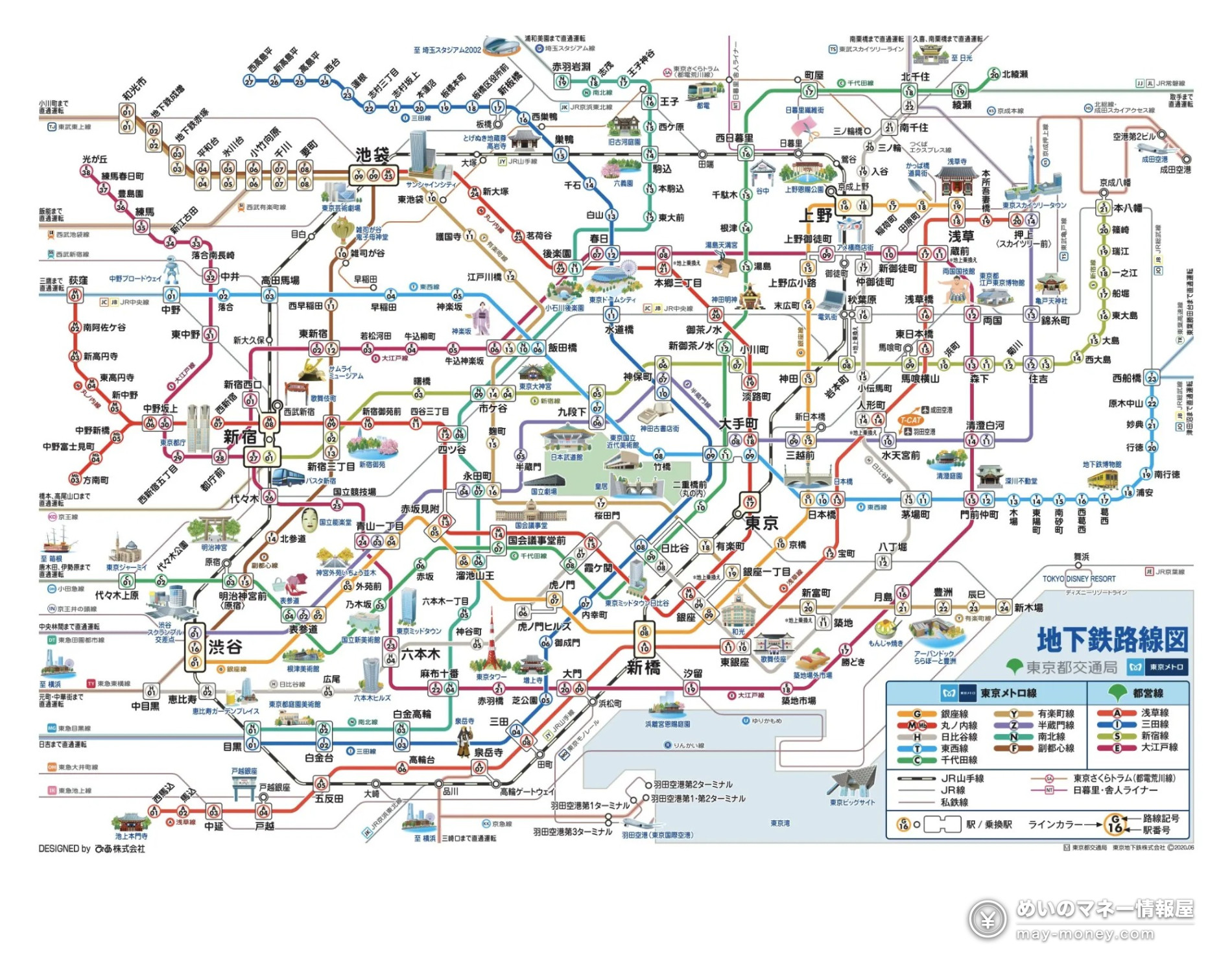
Watch out for through services: many Tokyo Metro trains continue straight onto Tokyu, Odakyu, Tobu, Seibu or JR lines. If you stay on board past the boundary, that part of the trip isn’t covered (see what to do).
Buying it on the Japanese-only site, step by step
The sales site has no English version, so here are the Japanese labels you’ll need along the way.
- Open the sales site and create an accountThe site is Tokyo Metro’s official ticket shop, operated by LINKTIVITY. First-time users sign up with an email address (look for “新規登録”, new registration).
- Choose that weekend’s 28-Hour Ticket and payUnder “おトクな乗車券” (value tickets), choose “土日祝限定東京メトロ28時間券(QR)” with that weekend’s dates, set the number of adult (大人) and child (小児) tickets and tap “注文へ進む” (proceed to order). Pay by credit or debit card (VISA, Mastercard, JCB, American Express or Diners). 3D Secure is required; cards without it won’t go through. The ticket is then sent to your email.
- Press “利用開始” right before you rideOpen the ticket from “マイページ” (My Page) → “予約情報” (reservations) and press the “利用開始” (start using) button. After that, the ticket can no longer be refunded, so press it at the gate.
- Hold the QR code over the gate’s QR readerLook for the reader marked “QR” on the automatic ticket gate – it’s not the same spot where you tap an IC card. Scan it again when you exit.
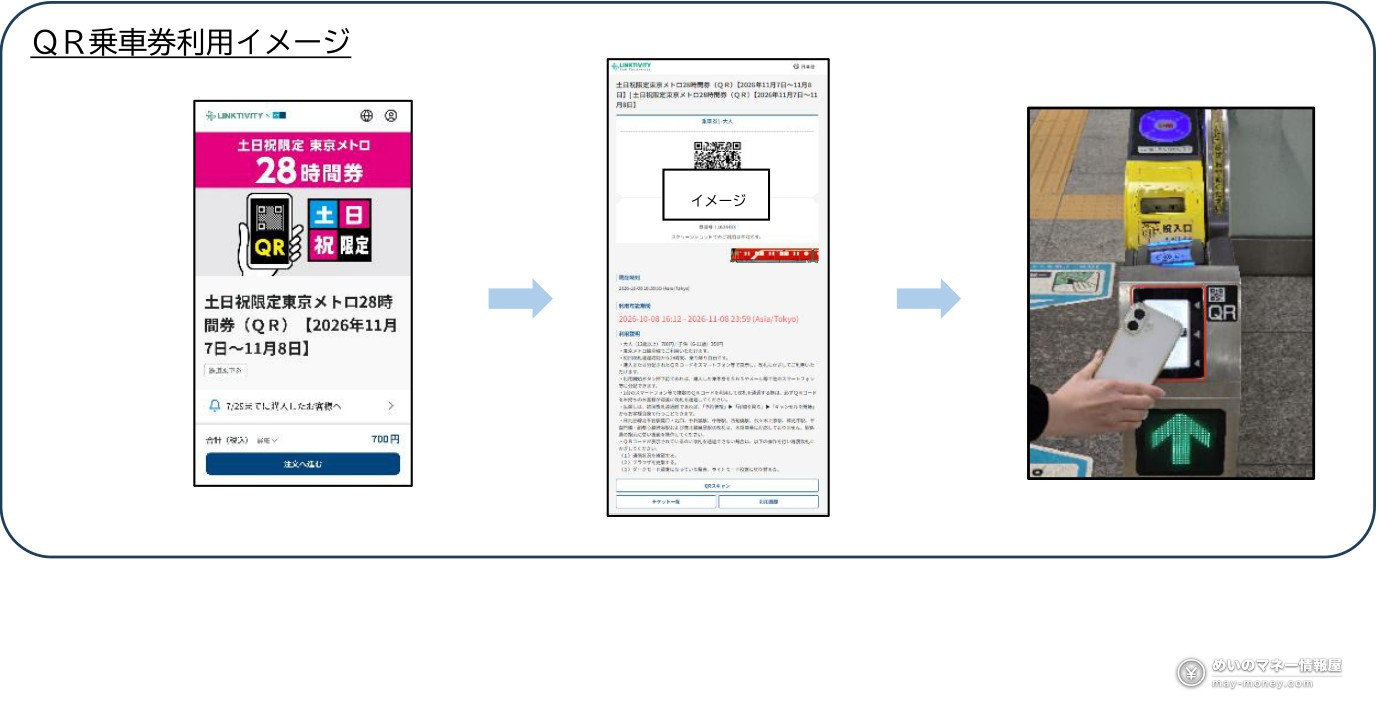
Travelling with family or friends? You can buy several tickets in one payment and, before pressing “利用開始”, share them to your companions’ phones by messaging app or email – each person needs their own QR code. If several QR codes go through the gate on one phone, the person holding the phone goes last.
Eight stations where the QR code won’t scan
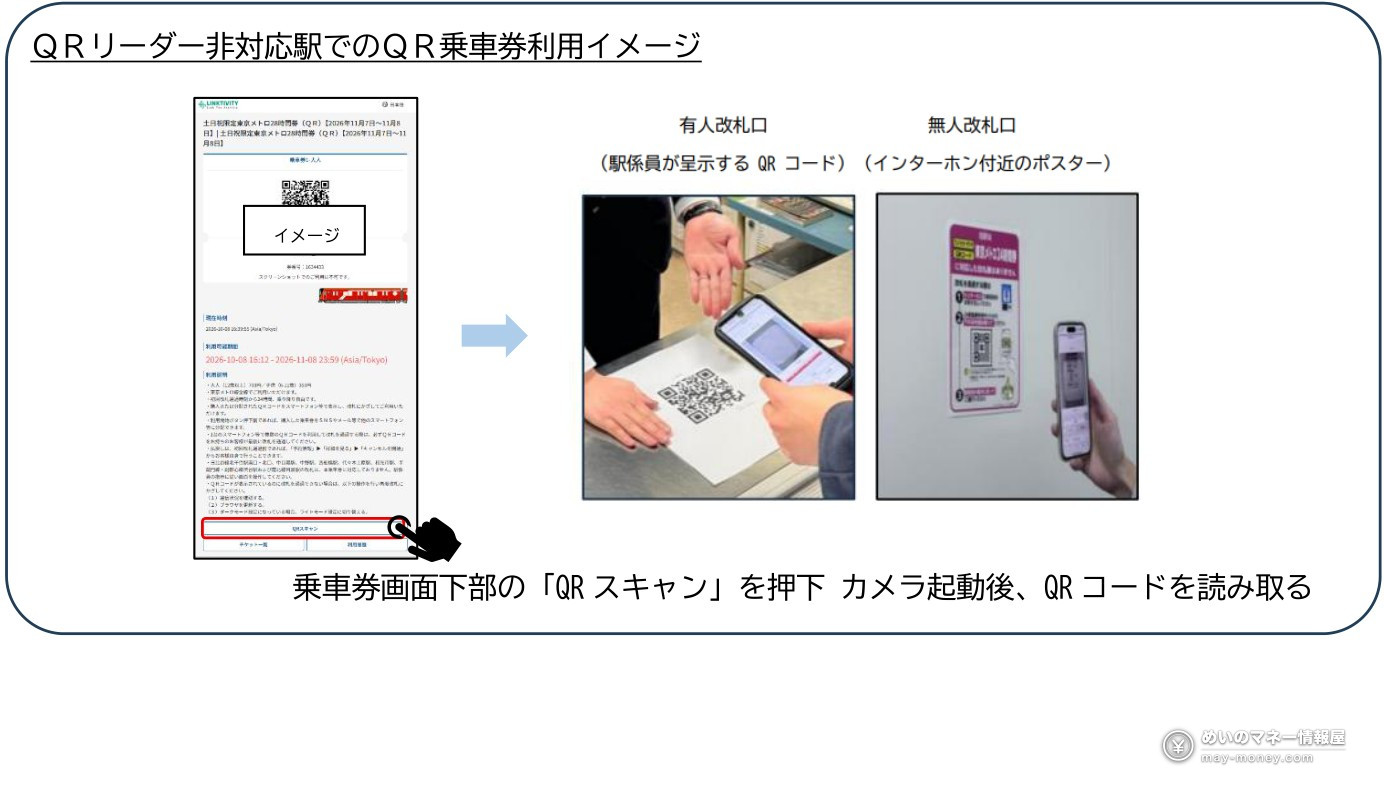
These gates – mostly at stations shared with other railway companies – have no QR reader for this ticket:
- Kita-Senju Station, Hibiya Line (South and North Exits)
- Naka-Meguro Station
- Nakano Station
- Nishi-Funabashi Station
- Yoyogi-Uehara Station
- Wakoshi Station
- Shibuya Station, Hanzomon and Fukutoshin Lines
- Meguro Station, Namboku Line
At these stations, go to the staffed window at the gate. The staff will show you a QR code; tap “QRスキャン” (QR scan) at the bottom of your ticket screen, scan their code with your phone’s camera, and follow their directions. If nobody is at the window, follow the poster near the intercom to call staff. It can take a while for someone to arrive, so allow extra time.
Things to know before you buy
- No advance sales: on sale only from Saturday 4:00 a.m. to Sunday 3:00 p.m. of that weekend
- First entry by Sunday 11:59 p.m., or the ticket becomes invalid (Monday, Nov 23 for the long weekend)
- Going beyond Tokyo Metro: exit at the connecting station with this ticket, then ride the other company’s line with an IC card or a separate ticket. Coming from another line works the other way round – exit at the connecting station with your IC card, then enter again with this ticket
- Screenshots and printouts don’t work. If your phone dies or breaks, you’ll have to buy a separate ticket (stations don’t provide charging). Staff may ask to see your ticket screen
- Refunds are only possible before you press “利用開始”, with a ¥220 fee. The press release says per ticket; the sales site says per payment, and all tickets bought in one payment are refunded together
- Don’t buy the wrong one: the same site sells the 24-Hour Ticket (QR) for the same ¥700
The 28-Hour Ticket’s sales page also mentions “Chikatoku” (ちかとく): show an eligible day ticket at partner museums, galleries, restaurants and shops to get discounts or small gifts. Check which tickets qualify and what each place offers on the official Chikatoku site before you go.
28-Hour vs. 24-Hour vs. other day passes
| Ticket | Adult | Covers | Valid for | Where to buy |
|---|---|---|---|---|
| Weekend & Holiday 28-Hour Ticket (QR) | ¥700 | All Tokyo Metro | 28 hours from entry | Sales site only (that weekend) |
| Tokyo Metro 24-Hour Ticket | ¥700 | All Tokyo Metro | 24 hours from entry | Station machines (same day), advance, QR version |
| Tokyo Metro & Toei One-Day Ticket | ¥1,100 | Tokyo Metro + Toei Subway | First to last train on one day | Station machines, QR version |
| Tokyo Furii Kippu | ¥1,720 | Tokyo Metro + Toei + JR within the 23 wards | First to last train on one day | Station machines |
| Tokyo Subway Ticket | ¥1,000 (24h) ¥1,500 (48h) ¥2,000 (72h) | Tokyo Metro + Toei Subway | 24/48/72 hours from entry | Visitors only (see below) |
- Going out on both Saturday and Sunday, staying on Tokyo Metro → 28-Hour Ticket
- Weekdays, or just one day out → 24-Hour Ticket (same ¥700, sold at station machines; the QR version can be used on any day within 90 days of purchase)
- Need the Oedo, Asakusa, Mita or Shinjuku lines → Tokyo Metro & Toei One-Day Ticket
A note for residents: the Tokyo Subway Ticket is only sold to foreign tourists and people who live outside Tokyo, Kanagawa, Saitama, Chiba, Ibaraki, Tochigi, Gunma and Yamanashi. If you live in the Tokyo area, choose from the other tickets above.
QR tickets are spreading to other lines too – the Tsukuba Express one-day pass has also gone QR (our TX pass guide).
Weekend ideas along Tokyo Metro lines
November and December bring illuminations and Christmas markets. Here are events we’ve covered that are reachable by Tokyo Metro and overlap with the sale period:
| Event | Dates | Tokyo Metro station |
|---|---|---|
| Shibuya Furusato Festival | Nov 7–8 | Chiyoda Line Yoyogi-koen |
| ARK HILLS CHRISTMAS | Nov 7 – Dec 25 | Namboku Line Roppongi-itchome |
| Tokyo Square Garden Winter Illumination | Nov 5 – Jan 31 | Ginza Line Kyobashi (direct) |
| HIBIYA Magic Time Illumination | Nov 12 – Feb 28 | Hibiya / Chiyoda Lines Hibiya |
| Tokyo Midtown Yaesu Christmas | Nov 19 – Dec 25 | Marunouchi Line Tokyo (via Yaesu underground mall) |
| Tokyo Dome City SNOW DOME | Nov 19 – Feb 28 | Marunouchi / Namboku Lines Korakuen |
| Tokyo Skytree Town Christmas Market | Nov 5 – Dec 25 | Hanzomon Line Oshiage |
| Happo-en Autumn Light-up | Nov 27 – Dec 6 | Namboku Line Shirokanedai |
For the November 7–8 weekend, for example: head to the Shibuya Furusato Festival in Yoyogi Park on Saturday afternoon, see the lights in Kyobashi in the evening, and take the Hanzomon Line to the Skytree Christmas market on Sunday. With trips to and from home that’s five rides – ¥890 even at the cheapest IC fare, more than the ¥700 ticket. Find more weekend plans in our Japan event calendar.
FAQ
- Q. How is it different from the Tokyo Metro 24-Hour Ticket?
- The price (¥700 adults, ¥350 children) and the coverage (all Tokyo Metro lines) are the same; the 28-Hour Ticket lasts four hours longer. In exchange, it is sold only on weekends, has no advance sales and comes only as a QR code on your phone. The 24-Hour Ticket is sold every day, including at station ticket machines.
- Q. Can I buy it on Friday?
- No. There are no advance sales; it is only on sale from 4:00 a.m. Saturday to 3:00 p.m. Sunday of that weekend.
- Q. I only decided to go out on Sunday afternoon. Is it too late?
- No. Buy it by 3:00 p.m. on Sunday and enter a gate by 11:59 p.m., and you get 28 hours from that entry – which can run into Monday.
- Q. Can I ride the Toei Oedo or Asakusa lines?
- No. Only the nine Tokyo Metro lines are covered. If you need Toei Subway too, get the Tokyo Metro & Toei One-Day Ticket (¥1,100 for adults).
- Q. What if my train runs through onto the Tokyu or Odakyu line?
- Sections outside Tokyo Metro aren’t covered. Exit at the connecting station with this ticket, then ride the other line with an IC card or a separate ticket.
- Q. How do I get tickets for my kids? How many people can use one phone?
- Choose the child ticket (¥350) when buying. Each person needs their own QR code, and you can share tickets to companions’ phones before pressing “利用開始”. If several QR codes go through on one phone, the person holding it goes last.
- Q. Can I buy it without a credit card?
- Yes, with a debit card (VISA, Mastercard, JCB, etc.), but the card must be registered for 3D Secure. Station ticket machines don’t sell this ticket.
- Q. Can I use a screenshot of the QR code?
- No. Screenshots and printouts are not accepted; open the ticket screen on your phone and scan it.
- Q. Can I get a refund if I don’t use it?
- Yes, on the sales site with a ¥220 fee, as long as you haven’t pressed “利用開始”. After that, no refunds.
- Q. Which stations can’t scan the QR code?
- Kita-Senju (Hibiya Line, South and North Exits), Naka-Meguro, Nakano, Nishi-Funabashi, Yoyogi-Uehara, Wakoshi, Shibuya (Hanzomon and Fukutoshin Lines) and Meguro (Namboku Line). Ask the station staff and scan the code they show you with “QRスキャン” on your ticket screen.
Sources
- Tokyo Metro news release on the Weekend & Holiday 28-Hour Ticket (QR) (October 29, 2026, Japanese)
- News release attachment (PDF, Japanese)
- Official sales page for the November 7–8 ticket (Japanese)
- Tokyo Metro: one-day tickets (Japanese)
- Tokyo Metro: regular tickets and fares (Japanese)
- Tokyo Metro: fares and travel times on main routes (as of April 1, 2026, PDF, Japanese)
- Tokyo Metro: tickets for visitors (Tokyo Subway Ticket, Japanese)
This is my own summary of Tokyo Metro’s announcement. Prices, sale dates and rules are subject to Tokyo Metro’s official information.
The 28-Hour Ticket can only be bought online with a credit or debit card. If you don’t have a Japanese credit card yet, the Rakuten Card is a common first card for people living in Japan – no annual fee, an online application, and Rakuten points on everyday spending. See our Rakuten Card guide for the details.

Related Articles


Get new articles by email
We will email you when a new deals article goes up. You can choose the categories, too.