Last updated: (based on JR East’s November 10 press release)
From spring 2028, walk-through gates go live at every Yamanote Line station and more. No more taking your phone out to tap.
- Spring 2028Full rollout (all Yamanote stations and more)
- From April 2027Trial run (monitors recruited)
- Your current Mobile SuicaKeeps working as is
- Tapping still worksUse either kind of gate
On November 10, 2026, JR East announced Part 6 of its “Suica Renaissance” plan: walk-through gates that let you pass with your phone still in your pocket or bag, launching in earnest in spring 2028. Today it takes three moves — take the phone out, tap, put it away. Soon it takes one: walk.
This guide sorts the official announcement into the questions most people have: what changes, whether you need a new card or phone, where and when it starts, and how the trial works.
- Your phone stays in your pocket or bag while you walk through the gate — on the way out too
- It uses your current Mobile Suica. Commuter passes and balance carry over, and you can still tap as you do now
- You need a “walk-through compatible smartphone.” JR East says the model details will be announced once decided
- Trial from April 10, 2027 (about 400 monitors, so not open to everyone) → full rollout in spring 2028: all Yamanote Line stations, the Narita Airport stations, the Tokyo Monorail Haneda Airport stations, Monorail Hamamatsucho and more — 40 stations in total
- The goal is every station with ticket gates (about 550) by the end of fiscal 2031
How it differs from tap-and-go
JR East describes this as Suica evolving from “tap and go” to “walk-through.” If you use Mobile Suica on a walk-through compatible smartphone, you skip the whole routine of taking the phone out and tapping, and you pass at the same speed as when you tap today. JR East says it stays smooth in the commuter rush too.
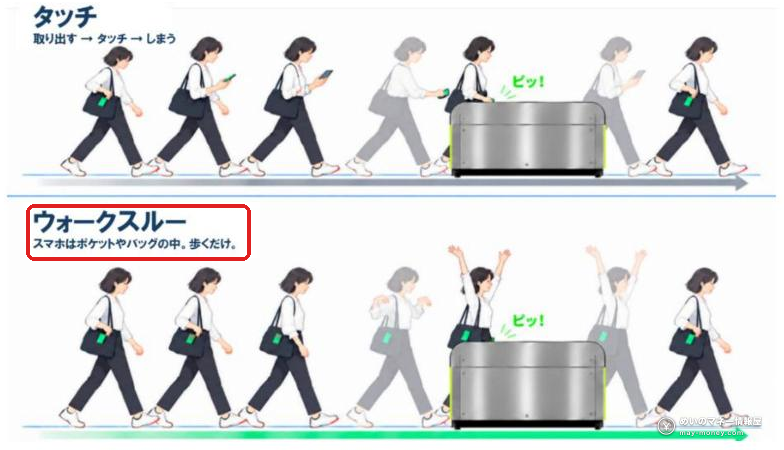
| Today (tap and go) | Walk-through | |
|---|---|---|
| What you do | Take out, tap, put away | Phone stays in pocket or bag. Just walk |
| Signal range | NFC: a few cm | UWB: a few m |
| With big luggage | You have to dig out the phone | JR East’s materials say “even with large luggage” |
| With a stroller or wheelchair | You have to dig out the phone | “Even with a stroller” and “even in a wheelchair” |
| Speed through the gate | Same as tapping | Unchanged, and smooth at rush hour |
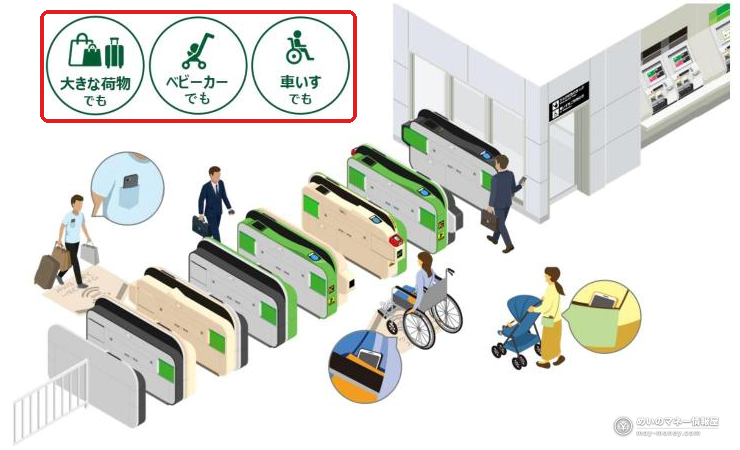
No new card: your Mobile Suica works as is
The walk-through gate uses the Mobile Suica already on your phone. Your commuter pass and stored balance carry over, so the same phone works at walk-through gates and at regular tap gates.
- Two ways through: walk, or tap like you do now
- Existing services are unchanged: riding past your pass section, paying with the Suica balance (SF), and so on
- You don’t need to think about which station has which gate: board at a station with a walk-through gate and get off where there isn’t one, and you tap out as usual. The reverse works the same way
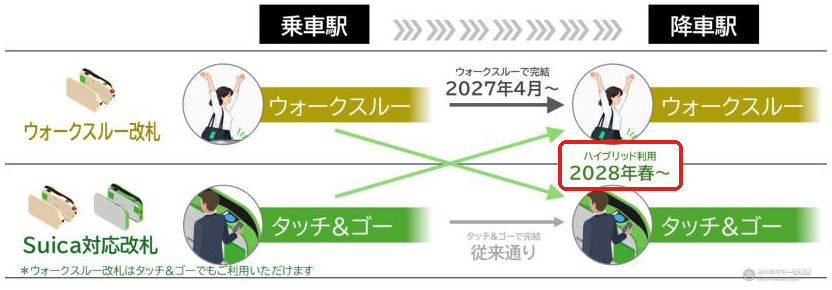
You need a walk-through compatible smartphone. JR East will announce the model details once they are decided, and we will add them here. Until then, keep using Mobile Suica as you do now.
Nothing. Keep using Mobile Suica and wait for the compatible-model list and the trial recruitment details. For how to earn and use JRE POINT, see our JRE POINT guide.
When and where (timeline)
- May and October 2026Hands-on demos of the UWB walk-through gate at “GATEWAY Tech TAKANAWA 2026” in Takanawa Gateway (May 13–14) and at CEATEC 2026 (October)
- November 10, 2026JR East announces Suica Renaissance Part 6
- April 10, 2027 – February 29, 2028Trial run at 14 stations, open to recruited monitors (about 400). It starts with use inside the commuter-pass section, and the scenes and the people covered widen in stages based on the results
- Spring 2028Full rollout: all Yamanote Line stations, the Narita Airport stations, the Tokyo Monorail Haneda Airport stations, Monorail Hamamatsucho and more — 40 stations in total. Each ticket-gate area gets one walk-through lane for entering and one for exiting
- End of fiscal 2031 (goal)Every station with ticket gates (about 550), across Shinkansen and conventional lines, in the Tokyo area and beyond
- Mid-2030s (goal)A GPS-based “smartphone gate” (working name) so that, across all JR East stations, moving through a station feels no different from moving outside it
Stations for the spring 2028 rollout
- All Yamanote Line stations
- Monorail Hamamatsucho
- Narita Airport stations
- Tokyo Monorail Haneda Airport stations
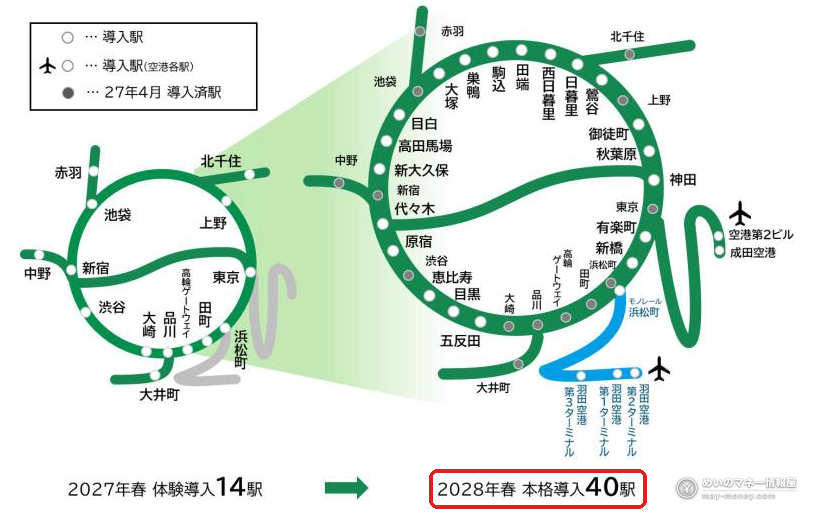
JR East’s October 2025 earnings materials aimed for walk-through gates on conventional lines in the wider Shinagawa area as early as fiscal 2028. The new announcement moves the start to spring 2028 and widens it to 40 stations, including every Yamanote Line station (reported by Norimono News).
The trial: who can join and how
Before the full rollout, a trial runs from April 10, 2027. Here is what the official materials say.
| Period | April 10, 2027 – February 29, 2028 |
|---|---|
| Purpose | Checking gate-processing accuracy and how it copes with crowds |
| Who | About 400 monitors chosen from people holding a commuter pass between the trial stations |
| Conditions | Walk-through for both entering and exiting, inside the commuter-pass section |
| Gates | Tap and go also works at the walk-through gates. During the trial, you use walk-through gates at both ends (for example, board at Tokyo, get off at Hamamatsucho) |
| Phone | A walk-through compatible smartphone with a trial app is lent out (developed with Sharp) |
| Details and recruitment | The trial details and how monitors are recruited will be announced separately |
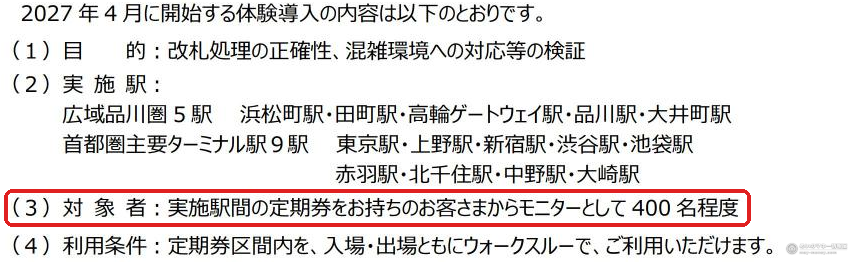
The 14 trial stations
Wider Shinagawa area: 5 stations
- Hamamatsucho
- Tamachi
- Takanawa Gateway
- Shinagawa
- Oimachi
Major Tokyo-area terminals: 9 stations
- Tokyo
- Ueno
- Shinjuku
- Shibuya
- Ikebukuro
- Akabane
- Kita-Senju
- Nakano
- Osaki
The trial is run by recruiting monitors, and the target is people with a commuter pass between these 14 stations. We will add the recruitment details here once they are announced.
What the gates look like
The walk-through gate builds on today’s gates. JR East’s installation image shows three changes.
- 1A UWB antennaA UWB antenna is added to the existing gate to talk to your phone.
- 2A different body colorThe gate’s body color changes, so you can tell it apart at a glance.
- 3A new pictogram on the lane lampAn extra pictogram on the lane indicator marks it as a walk-through gate.
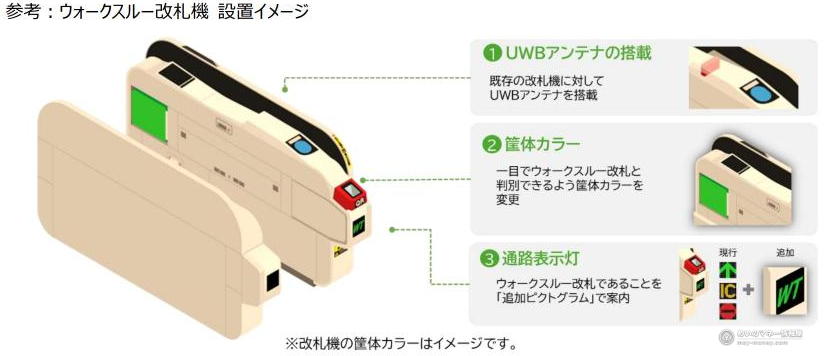
Tap and go also works at the walk-through gates. The body color in JR East’s image is only an illustration.
How it works: UWB and the development partners
Walk-through gates use a communication technology called UWB (Ultra-Wide Band). Today’s NFC needs the phone within a few centimeters, while UWB works over a few meters. In JR East’s diagram, the gate first measures where the phone is (positioning), then exchanges data once the phone reaches the communication spot.
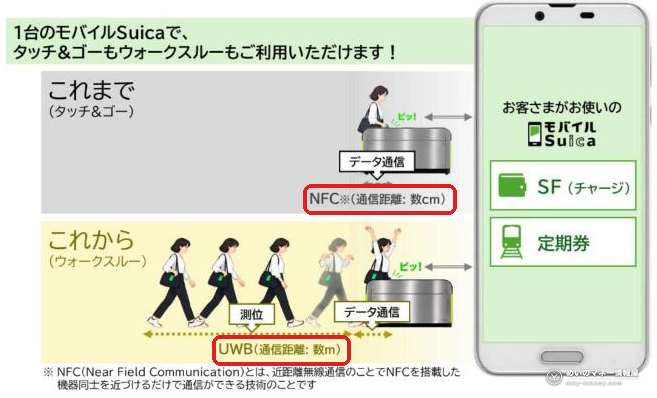
What is inside the phone does not change. Your commuter pass and balance are the ones in your current Mobile Suica, which is why both tapping and walking through work.
| Partner | Role |
|---|---|
| Sony | Developing and manufacturing the walk-through reader/writer |
| FeliCa Networks | Developing the security software for walk-through compatible smartphones |
| JR East Mechatronics | Developing and installing the walk-through gates |
Why UWB
In May 2026, JR East let visitors try a UWB walk-through gate at “GATEWAY Tech TAKANAWA 2026” in Takanawa Gateway. A JR East representative called UWB the front-runner and gave speed as the reason, especially for busy city stations where many people pass in a short time. According to ITmedia NEWS, a Suica gate can handle up to 60 people a minute, so speed is a hard requirement. JR East also tested face-recognition gates at Niigata and Nagaoka on the Joetsu Shinkansen (November 6, 2025 to March 31, 2026), so it is comparing methods side by side (sources at the end).
Part 6 within Suica Renaissance
| Part | Announced | What it is |
|---|---|---|
| 2 | Nov 11, 2025 | A new QR-code payment added to the Mobile Suica app (teppay, rolling out from Oct 20, 2026) |
| 3 | Dec 9, 2025 | “Local Suica” to solve regional problems |
| 4 | Jun 9, 2026 | Early access to “JRE GO,” the Shinkansen e-ticket service |
| 5 | Sep 8, 2026 | Merging the six Suica usage areas into one by the end of fiscal 2026 |
| 6 | Nov 10, 2026 | Full rollout of walk-through gates from spring 2028 (this article) |
Frequently asked questions
- Can I really walk through without taking out my phone?
- Yes. JR East’s plan is that people using Mobile Suica on a walk-through compatible smartphone can pass the gate without taking the phone out to tap, at the same speed as tapping today. Full rollout starts in spring 2028.
- Do I need to replace my current Mobile Suica?
- No. It works as is. Your commuter pass and balance carry over, and tap and go keeps working.
- Which phones will work?
- You need a walk-through compatible smartphone. JR East says the model details will be announced once decided.
- Which stations get walk-through gates in spring 2028?
- All Yamanote Line stations, the Narita Airport stations, the Tokyo Monorail Haneda Airport stations, Monorail Hamamatsucho and more — 40 stations in total.
- When can I try it?
- A trial runs from April 10, 2027 to February 29, 2028 at 14 stations. Participants are recruited monitors, about 400 people.
- Can anyone join the trial?
- The target is about 400 monitors chosen from people who hold a commuter pass between the trial stations. JR East will announce the details and the recruitment method separately.
- Which 14 stations are in the trial?
- Hamamatsucho, Tamachi, Takanawa Gateway, Shinagawa and Oimachi (the wider Shinagawa area), plus Tokyo, Ueno, Shinjuku, Shibuya, Ikebukuro, Akabane, Kita-Senju, Nakano and Osaki (major Tokyo-area terminals).
- What if I board at a walk-through station and exit at one without it?
- You tap out as usual, and the same applies in reverse. During the trial, both ends are walk-through gates.
- Can a card-type Suica walk through too?
- In JR East’s announcement, the walk-through target is Mobile Suica on a walk-through compatible smartphone. Tapping, the way you do now, still works at the walk-through gates.
- Is there anywhere I can try it right now?
- Hands-on demos of the UWB walk-through gate were held at “GATEWAY Tech TAKANAWA 2026” in Takanawa Gateway in May 2026 and at CEATEC 2026 in October. The trial JR East has officially announced next is the one from April 10, 2027, run with recruited monitors.
- How many walk-through lanes does a station have?
- Each ticket-gate area gets one lane for entering and one for exiting. Tap and go also works at the walk-through gates.
- How far will this spread?
- The goal is every station with ticket gates (about 550) by the end of fiscal 2031. For the mid-2030s, JR East also plans a GPS-based “smartphone gate” (working name).
Summary
The takeaway is simple: at the gate, your phone can stay in your pocket or bag. Your current Mobile Suica keeps working, the trial begins in April 2027, and the full rollout reaches all Yamanote Line stations and more in spring 2028.
Sources
- JR East press release: “Suica Renaissance” Part 6, Full-Scale Introduction of Walk-Through Ticket Gates from Spring 2028 (November 10, 2026, in Japanese)
- Impress Watch: hands-on with the UWB walk-through gate (May 14, 2026, in Japanese)
- Norimono News: JR East to introduce a no-tap gate on conventional lines for the first time (November 13, 2025, in Japanese)
- Impress Watch: JR East walk-through gate demo at CEATEC (October 15, 2026, in Japanese)
- ITmedia NEWS: how walk-through gates could work in the next-generation Suica (December 17, 2024, in Japanese)
- JR East press release: Suica Renaissance Part 2 (November 11, 2025, in Japanese)
- JR East press release: Suica Renaissance Part 3 (December 9, 2025, in Japanese)
- JR East press release: Suica Renaissance Part 4 (June 9, 2026, in Japanese)
- JR East press release: Suica Renaissance Part 5 (September 8, 2026, in Japanese)
This guide is based on the official announcement and will be updated when JR East publishes more.
Related Articles


Get new articles by email
We will email you when a new deals article goes up. You can choose the categories, too.