Most AI tarot sites work the same way. You tap three cards out of a grid, and you get a paragraph per card that reads like a glossary entry: The Fool — new beginnings, spontaneity, a leap of faith. Three of those stacked together is not a reading. It is a definition list with your name on it.
Castarot spends its effort on exactly the part everyone else skips: the text that comes back after you draw. It is free, it does not ask for an account, and I pulled a real spread on it. The output is quoted below, unedited.
CASTAROT · AI TAROT READING
You can go and pull three cards right now
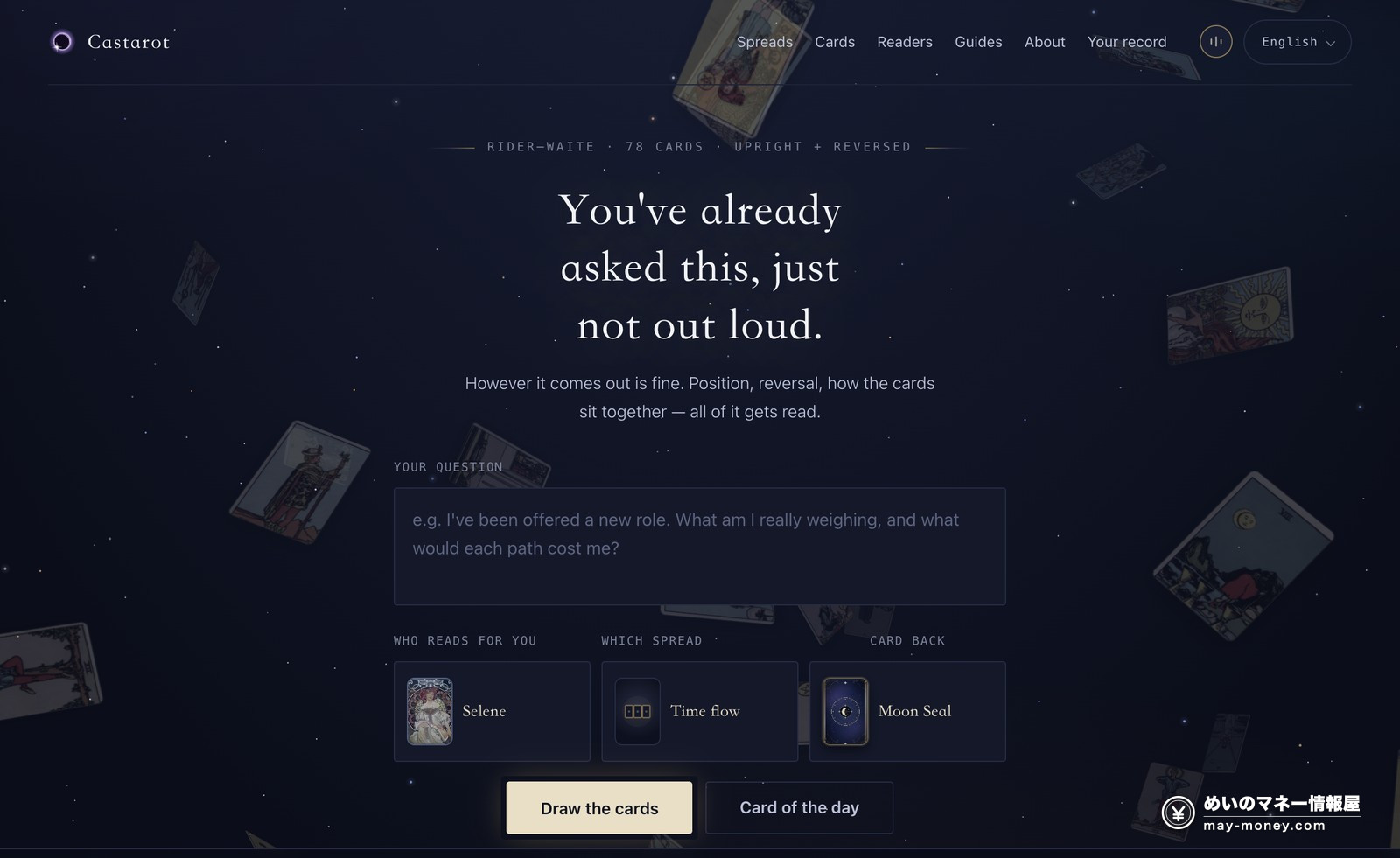
No account, no email. Write one question, pick a reader, hold the button while the deck scatters, let go.
- Rider–Waite 78 cards
- Choose your reader
- Choose the spread
- Free, no signup
The first draw needs no account. If it is not for you, close the tab.
What it is, in one box
AT A GLANCE
- Deck
- Rider–Waite, 78 cards, upright and reversed (see all of them)
- Readers
- Several to choose from, and more appear the longer you use it (current list: the readers)
- Spreads
- From one card to ten, sorted by what you would use them for (spreads)
- Price
- Free. The first draw does not even need an account
- Languages
- English, Japanese, Chinese and more — switcher at the top right
The part worth the whole review: the same reader remembers what you drew last time and picks the thread back up. More on that below.
I actually pulled a spread
Question: “I keep going back and forth on whether to leave this job.” Three cards, the Time flow spread. Everything below is from that session.
1. You write the question. You do not pick it from a menu
There is no Love / Career / Money selector. One text box. Whatever you type is what the reader works from.
If you are stuck, the bar at the bottom cycles through examples — “Is the money actually short, or am I just afraid to spend it?” They are all one level in from the obvious question, which sets the tone well.
2. Pick a reader
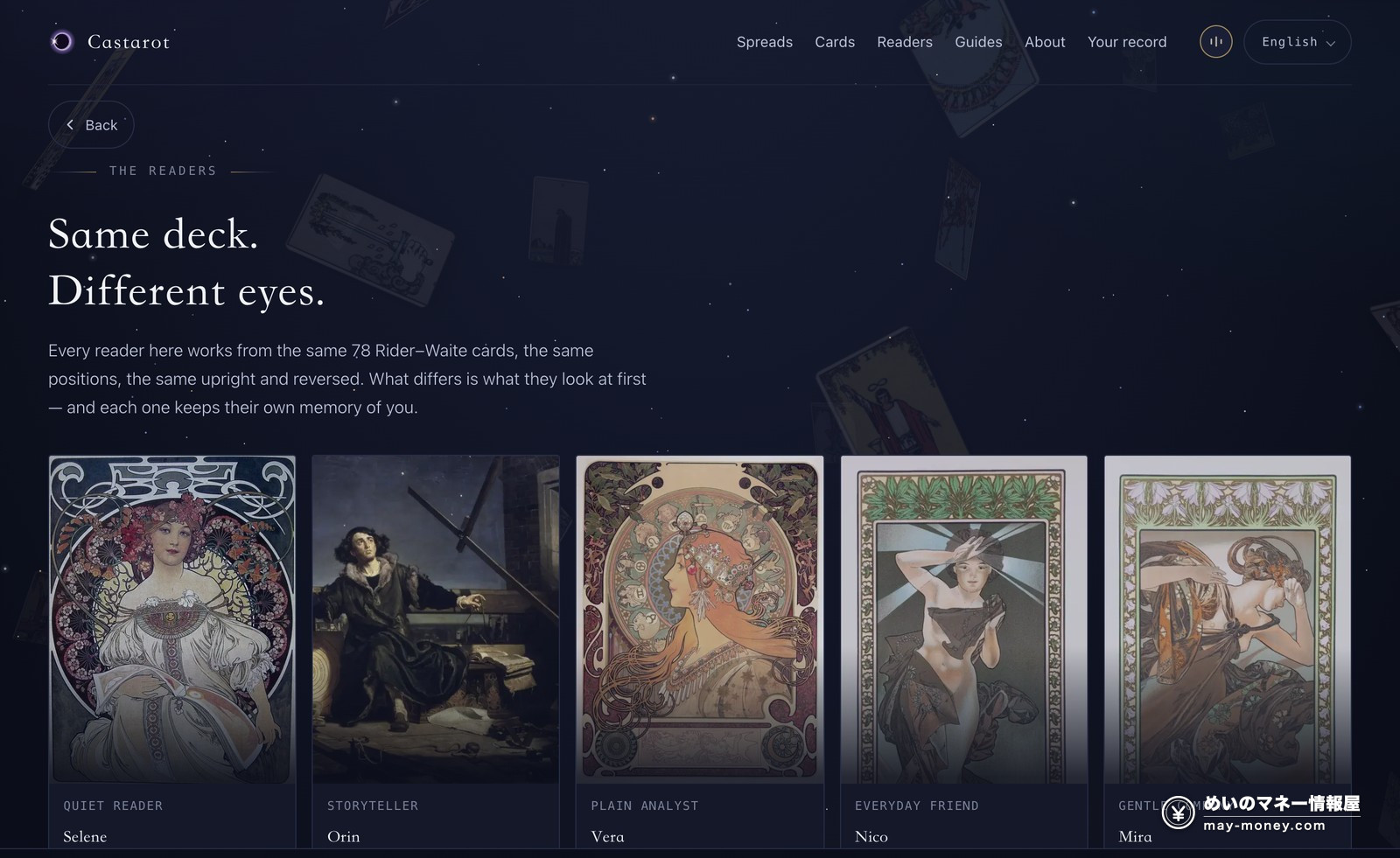
This is the best idea on the site. The readers are not one voice with different adjectives — they start in genuinely different places:
- QUIET READERSeleneLooks at what is drawn on the card before what it means
- STORYTELLEROrinReorders the cards and waits for a turn to show up
- REALISTVeraSeparates the facts, the cost, and what is still yours to choose
- LIGHT COMPANYNicoShort answers for small things, taken seriously anyway
- THE ONE WHO STAYSMiraOn a night with nothing visible, finds the side still lit
- ORDER AND COSTThaneReads the shape of the choice: its arc, its edge, its price
- READS POSITIONIrisThe same card does a different job depending on where it landed
Those were the ones available when I wrote this. The roster grows, so check the readers page for who is there now. Separately, there are readers who only show up once you have been drawing for a while — the conditions are tied to your own history, like the same card coming back repeatedly.
I went with Selene.
3. Hold the button and the deck actually shuffles
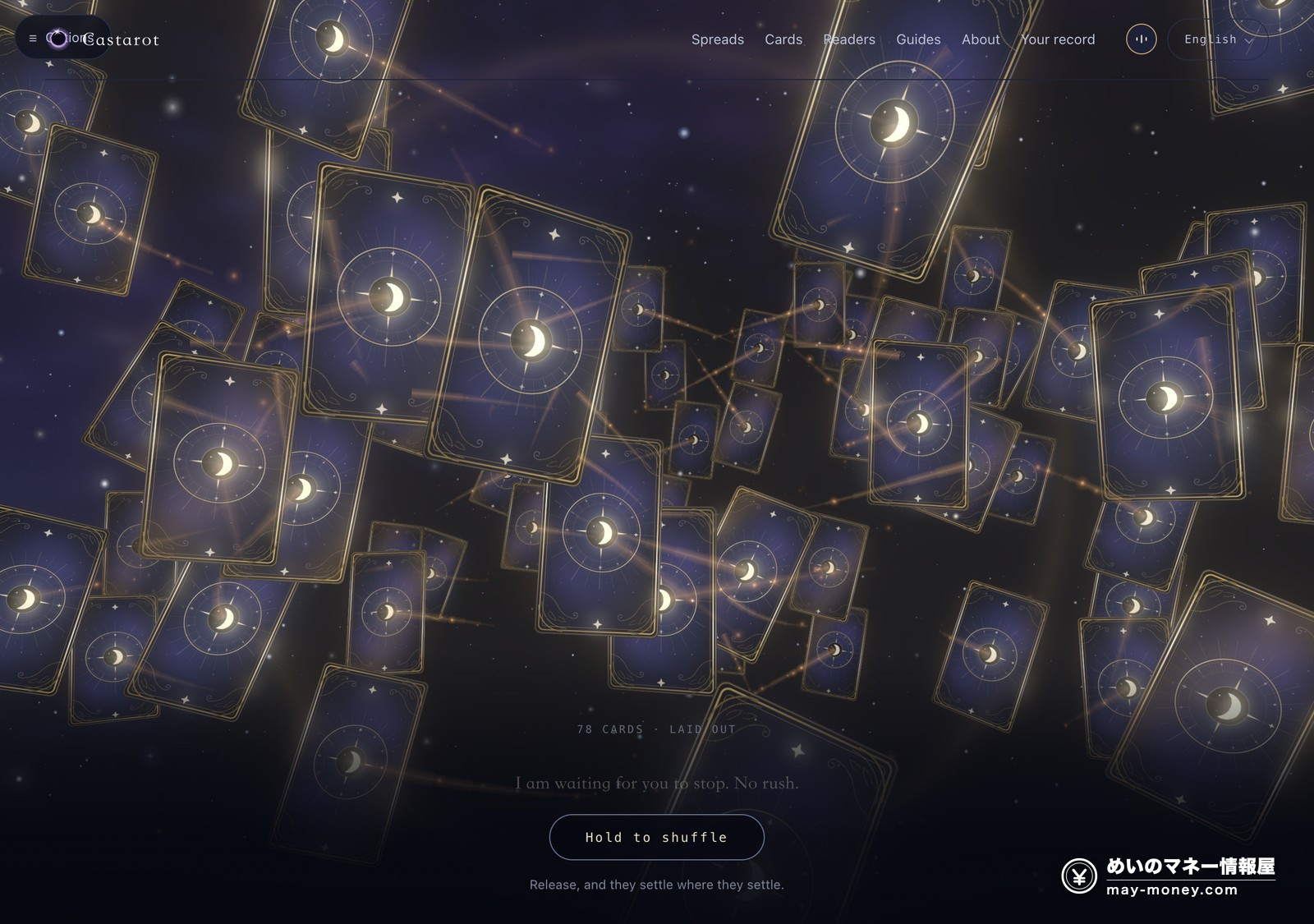
This is not a “Shuffling…” spinner. The 78 cards move while your finger is down and settle when you lift it. Two seconds or thirty, your call.
While you hold, the line from your chosen reader slowly comes into focus. Selene’s was “I am waiting for you to stop. No rush.” Turning the wait itself into the reader’s first line is a good piece of craft.
4. Take three, turn them over
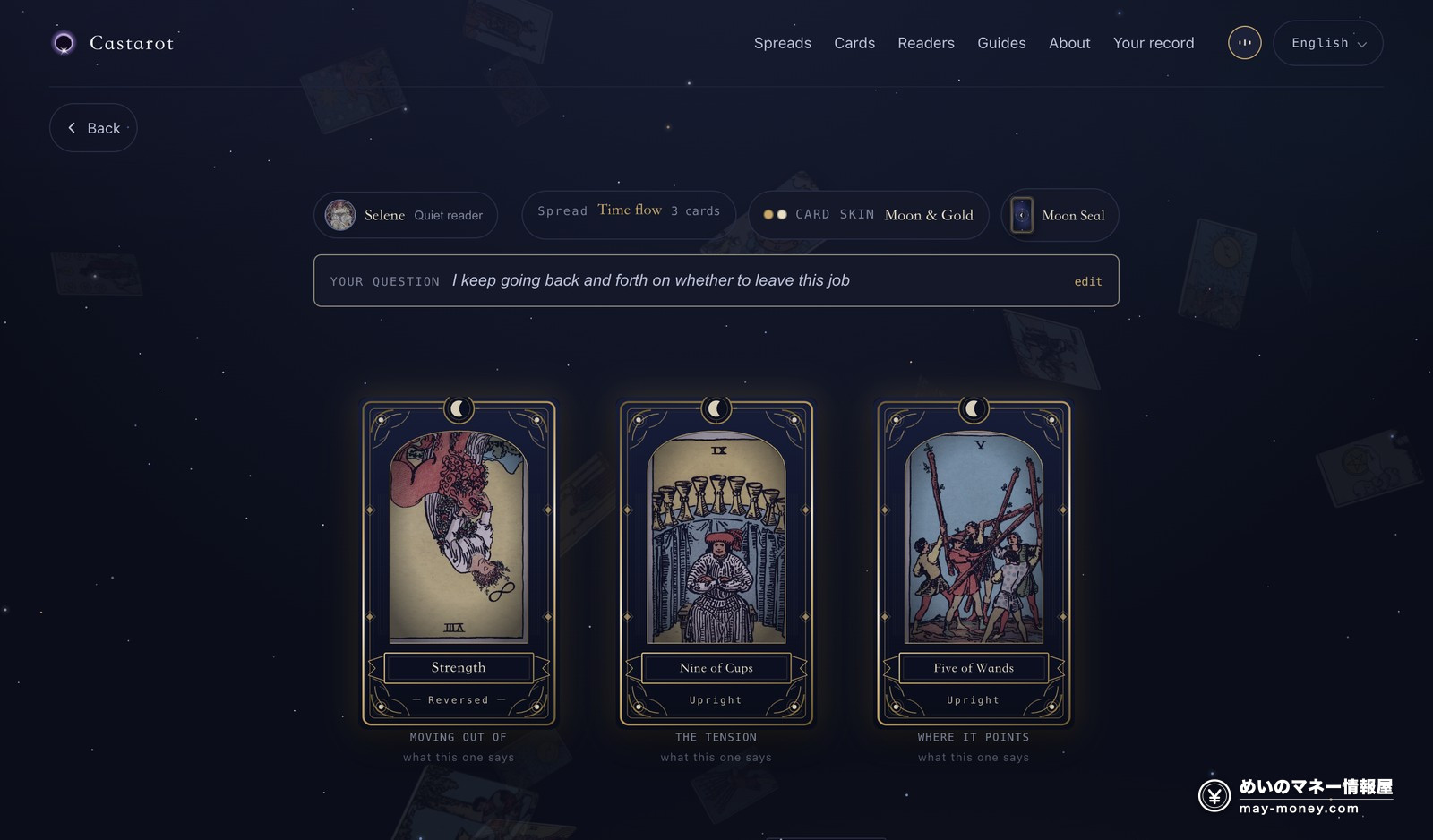
- Moving out of: Strength (reversed)
- The tension: Nine of Cups (upright)
- Where it points: Five of Wands (upright)
Tap any card name and you land on that card’s own page, so you can look the symbol up without leaving for another site.
5. What came back
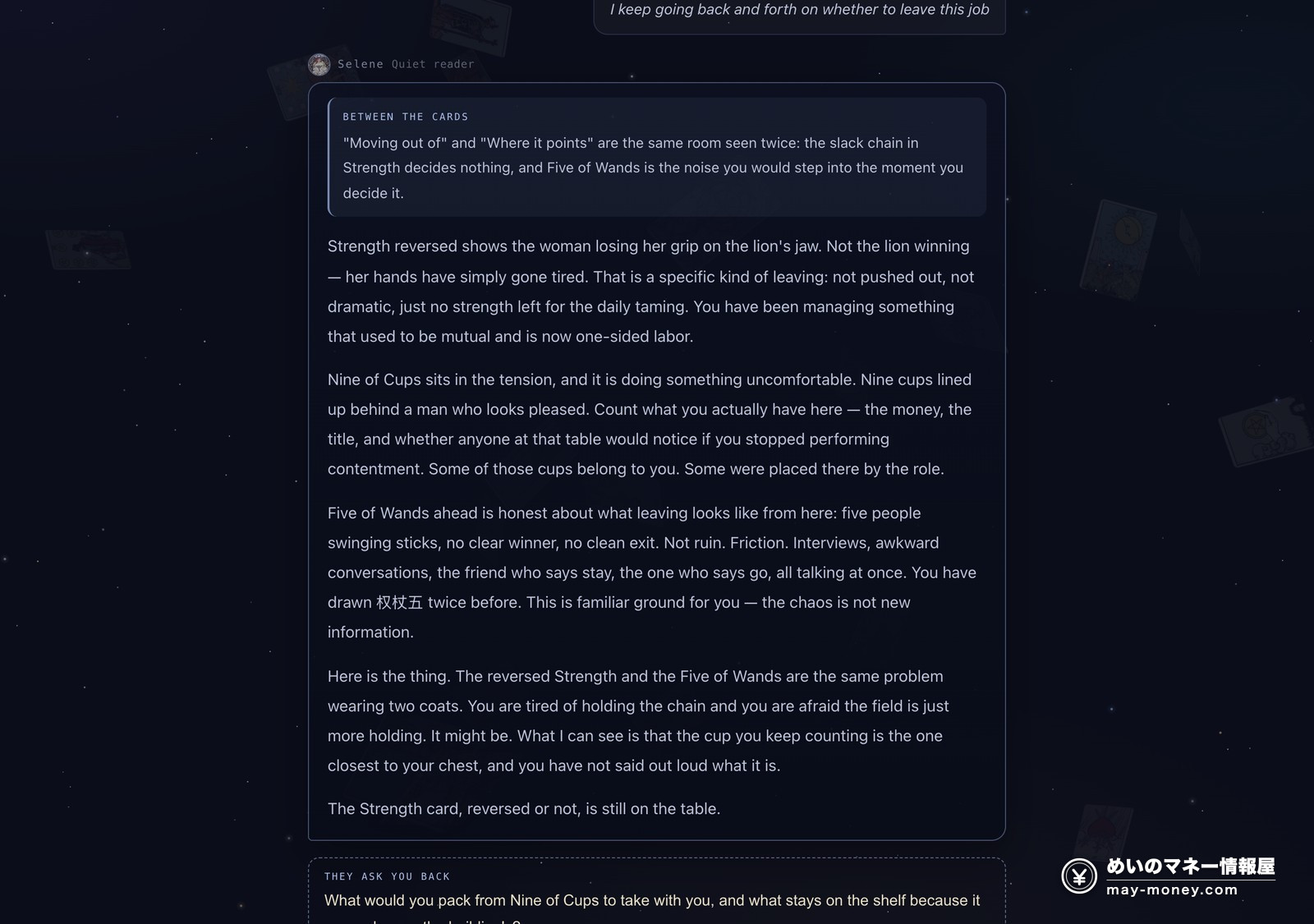
It opens with how the cards sit against each other, before any single card is interpreted:
BETWEEN THE CARDS — actual output
“Moving out of” and “Where it points” are the same room seen twice: the slack chain in Strength decides nothing, and Five of Wands is the noise you would step into the moment you decide it.
Then the first card:
Selene on Strength reversed — actual output
Strength reversed shows the woman losing her grip on the lion’s jaw. Not the lion winning — her hands have simply gone tired. That is a specific kind of leaving: not pushed out, not dramatic, just no strength left for the daily taming. You have been managing something that used to be mutual and is now one-sided labor.
No “Strength reversed = self-doubt, low confidence.” It goes in through what is drawn on the card — a hand that has gone tired on the lion’s jaw — and reads that against the position it landed in. That is Selene’s method, applied.
And it closes without telling you what to do:
The last line — actual output
The Strength card, reversed or not, is still on the table.
Nowhere does it say leave or stay. The decision stays yours from beginning to end, which is the hardest thing to get right in this format and the main reason the output does not feel like filler.
6. You can push back without starting over
Under the reading, the reader asks you something. Mine was about which of the Nine of Cups I would actually pack and which stays on the shelf. You answer there and the conversation continues — same question, same three cards, still on the table. Pasting a reading into a chatbot and asking a follow-up loses all of that context; here it does not.
What it does better than the rest
It remembers your last spread
Stay with the same reader and it will bring up cards that came back from previous sessions. Your history collects in your record, and a card that keeps returning can itself unlock a new reader. Every other AI tarot tool I have used treats each reading as if you had never been there.
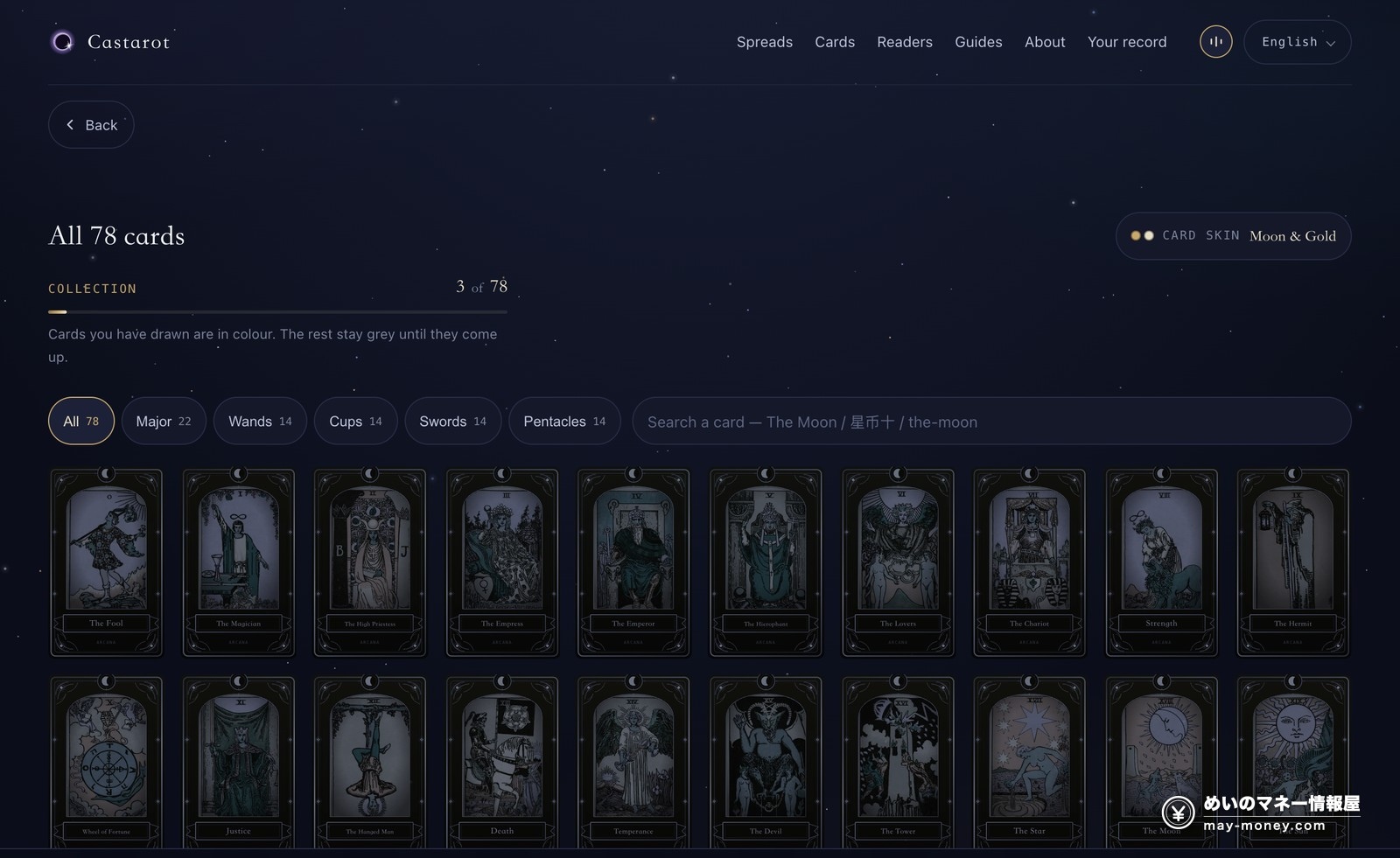
All 78 cards have a real page, not a stub
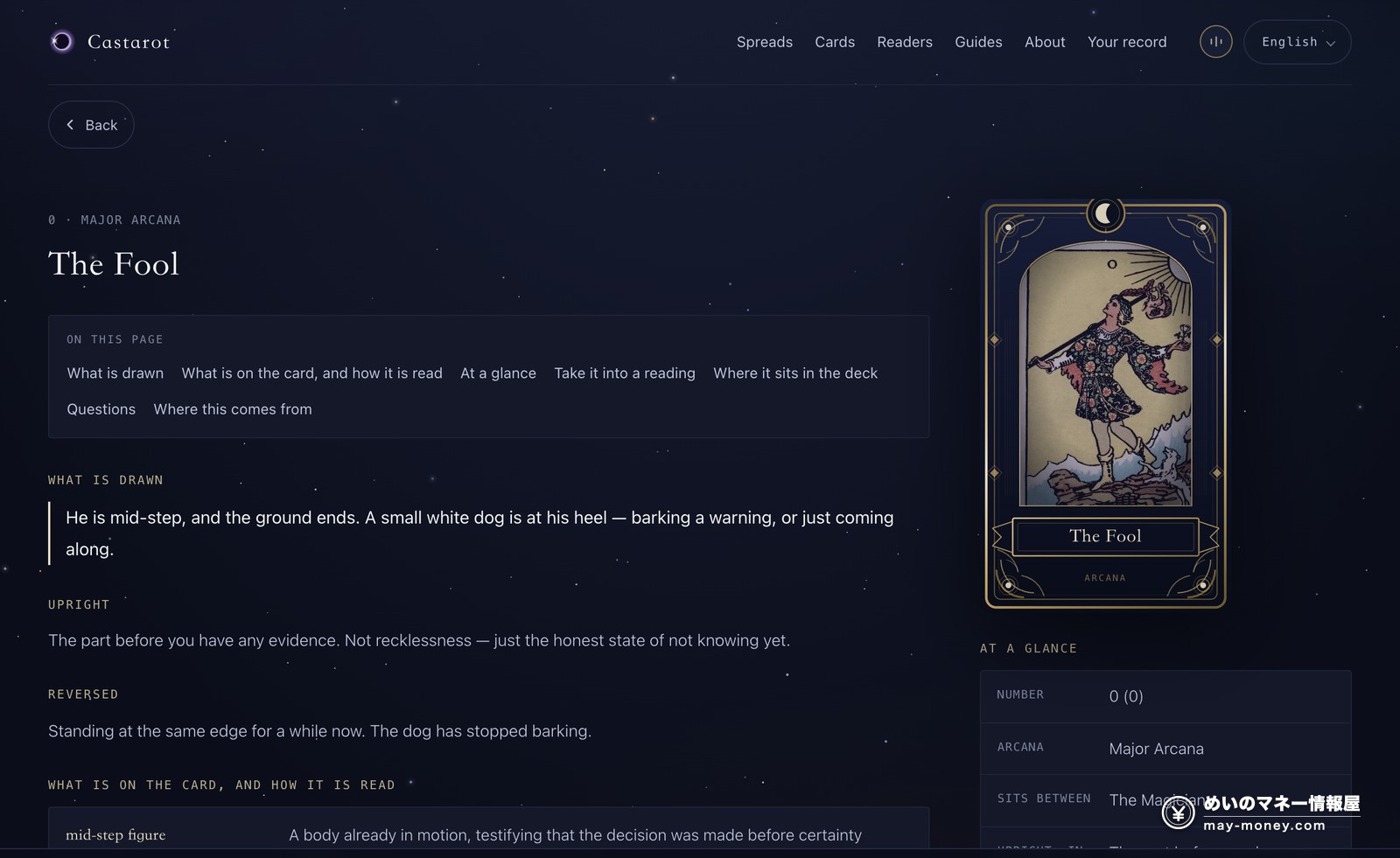
You can use the card pages without drawing anything. The Fool has upright and reversed, and then a breakdown of what is on the card and how each element is read — with a note that it only covers elements genuinely present on the 1909 plate, which rules out the invented symbolism these pages usually drift into.
The ones people draw most:
No upsell, no email wall
There is no paid tier, no “unlock the full reading”, and it never asks for an address. You draw, you read, you leave.
Choosing a spread
Each one says what it is for, not just how many cards. These were available when I wrote this, and more may be added:
- 1cardsMirrorOne card. No structure to hide inside
- 2cardsScalesOne on each side
- 3cardsTime flowThree with a direction. This is what I used
- 4cardsGroundNot ahead — underfoot
- 5cardsCrossroadsFor a choice that costs something either way
- 7cardsHorseshoeSeven in an arc, open side facing you
- 10cardsCrossThe long one
One or three is plenty to start. There is also a single card of the day as a separate, lighter entry point.
Price, account, languages
- Price: free, with no paid tier at present
- Account: not needed for the first draw
- Languages: English, Japanese, Chinese and more, switchable at the top right
- Artwork: the 1909 Rider–Waite plates, public domain
The thinking behind the site is in About, and tarot itself is covered in the guides.
Who it suits, and who it does not
It suits you if you do not want a verdict, you want the thing you are carrying put into words so you can look at it. It never concludes for you, and the length is right for thinking rather than skimming. If you want to learn the cards properly, the 78 pages stand on their own.
It does not suit you if you want dates, amounts, or which option pays better. It does not answer that way and never pretends to. And tarot is tarot — do not settle money or work questions on it alone.
The readers only speak inside a reading. They are not a companion chatbot, and the site is clear that it is not trying to be one.
Bottom line
There is no shortage of AI tarot. Castarot bets on two things — the quality of the text after the draw, and remembering the last one — and both hold up. It is free and needs no account, so the fastest way to judge it is to pull three cards.
CASTAROT · AI TAROT READING
One draw will tell you more than the rest of this review
Everything above is checkable in about three minutes. Free, no account, and the whole site is written in English rather than translated into it.
- Rider–Waite 78 cards
- Choose your reader
- Choose the spread
- Free, no signup
Tarot is tarot. Do not let it decide money or work on its own.