Aki no Norihodai Pass
Three straight days of unlimited JR local and rapid trains, nationwide
¥3,920 for children · on sale from September 18 · valid October 3–18
If you live in Japan, this is one of the very few unlimited rail passes you are actually allowed to buy — the nationwide Japan Rail Pass is off-limits to residents, this one is not. It is also the only nationwide local-train pass on sale in October: the Seishun 18 Ticket’s summer edition ended on September 8 and the winter edition does not start until December 11, and the Hokkaido & East Japan Pass has no October run either. At ¥7,850 it undercuts the three-day Seishun 18 Ticket by ¥2,150, and unlike that one, it has a child fare.
- What the pass actually is
- Yes, you can buy it — this is not the Japan Rail Pass
- The official announcement
- What you can ride, and what you can’t
- Five limited-express exceptions and four private lines
- Where to buy it, and what to say
- Does it pay for itself? ¥2,617 a day
- Versus the Seishun 18 Ticket
- Crossing to Hokkaido: the option ticket
- Planning the three days
- Eight things that trip people up
- FAQ
- Sources
What the pass actually is
The Aki no Norihodai Pass (秋の乗り放題パス, “autumn unlimited ride pass”) is a seasonal ticket the six JR companies issue together every autumn, timed to Railway Day on October 14. You name a start date when you buy it, and for three consecutive days you can get on and off any JR local (futsū) or rapid (kaisoku) train in the country, riding in the non-reserved ordinary cars.
Two things are bundled in that people routinely miss:
- Three BRT busways — the Kesennuma Line BRT (Yanaizu–Kesennuma), the Ōfunato Line BRT (Kesennuma–Sakari), and JR Kyushu Bus’s Hitahikosan Line BRT (Soeda–Hita).
- The JR West Miyajima ferry (Miyajimaguchi–Miyajima), normally ¥200 each way. You ride it as many times as you like at no extra cost — though the ¥100 Miyajima visitor tax is still collected separately when you land on the island.
You pick a start date at purchase and the clock runs for three days straight. You cannot skip a day and use it later. You also cannot split one pass between two people, and you cannot buy one pass for two children — the announcement spells out both.
Yes, you can buy it — this is not the Japan Rail Pass
Worth clearing up first, because it stops a lot of residents from even looking. The nationwide JAPAN RAIL PASS is restricted to people entering Japan on “Temporary Visitor” status. If you are here on a work, student, spouse, working-holiday or permanent-residence visa, you cannot buy or use it. A handful of regional JR passes are open to any foreign passport holder regardless of visa, but the big nationwide one is not.
The Aki no Norihodai Pass carries none of that. It is an ordinary JR ticket sold over the counter in Japan, with no restriction on age, nationality or residence status. Nobody will ask for your passport or residence card. Japanese commuters, foreign residents and tourists all buy exactly the same ticket.
The Seishun 18 Ticket, its better-known sibling, has the same open eligibility despite “18” in the name — that word refers to the spirit of youthful budget travel, not an age limit. Neither pass has one.
The official announcement
Here is page one of the JR Group release dated August 31, 2026. Sale dates, validity dates, prices and where it is sold are all on this single page, and every figure in this article is taken from it.
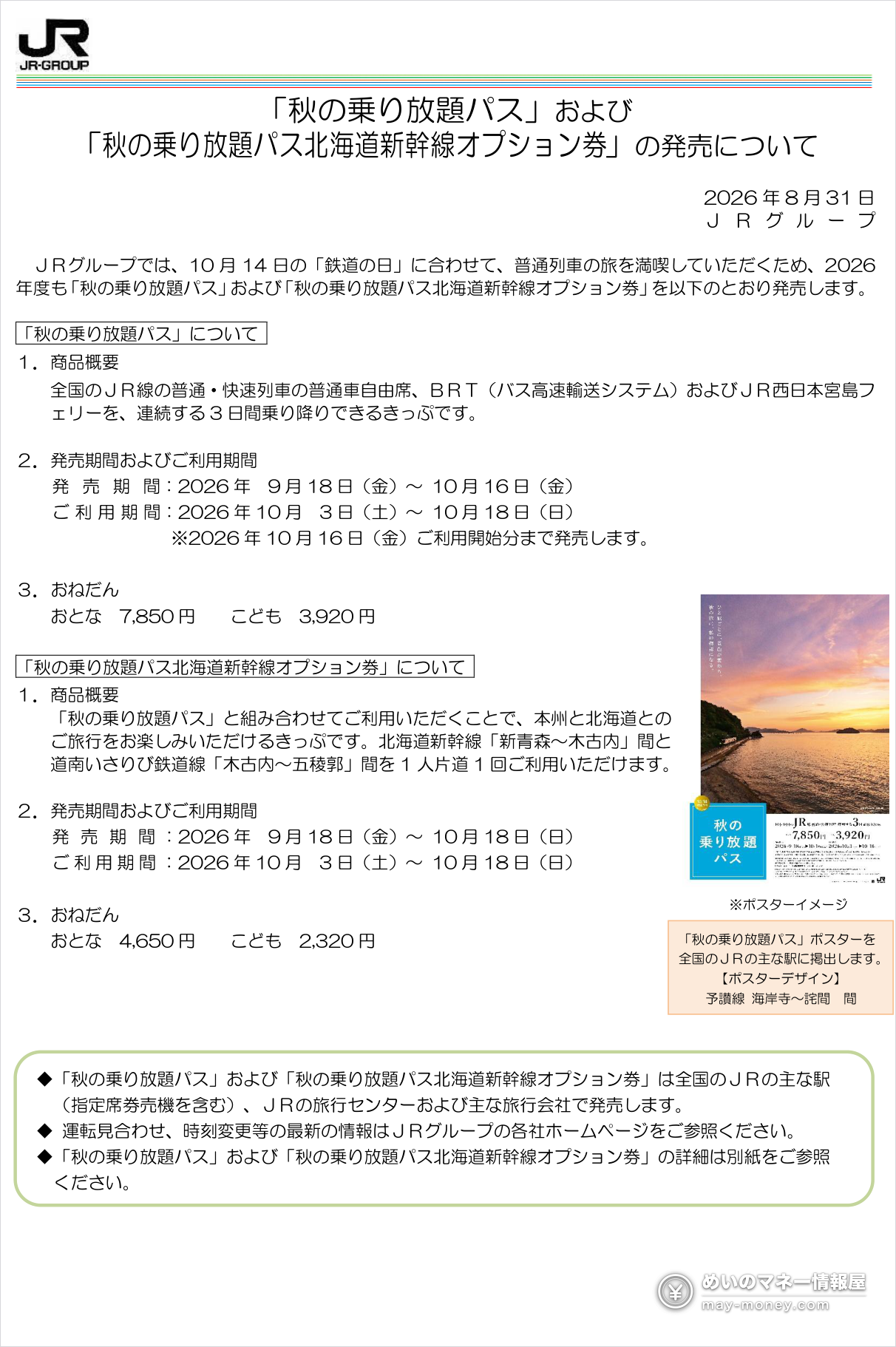
Source: JR Group, “Sale of the Aki no Norihodai Pass and the Aki no Norihodai Pass Hokkaido Shinkansen Option Ticket” (August 31, 2026), via the JR West newsroom. Captured September 12, 2026.
Page two — labelled “Appendix 1” — is where the real rules live: which private railways you may pass through, which five stretches let you board a limited express, and how changes and refunds work. Most of what follows is a reading of that page.
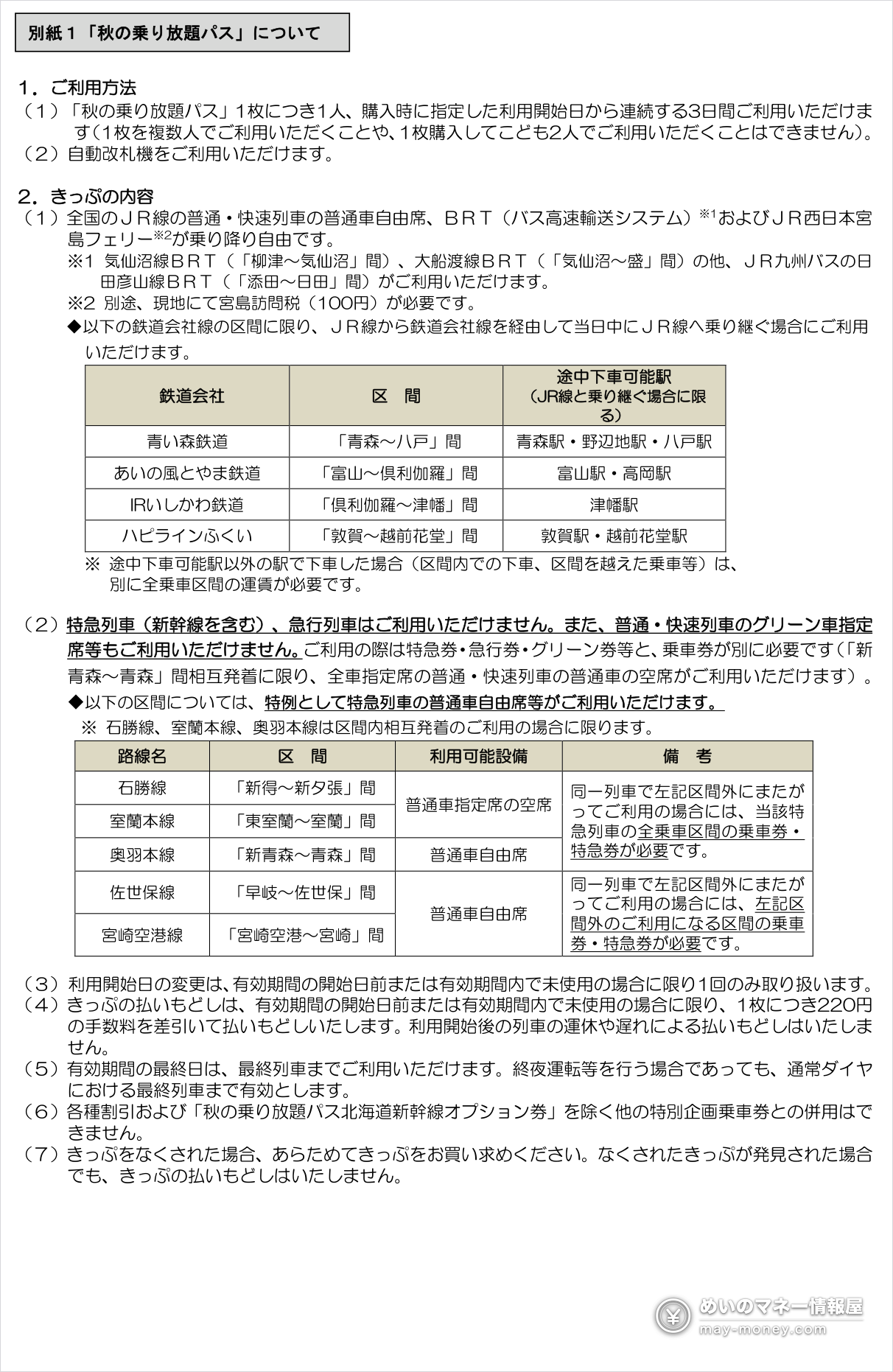
Source: Appendix 1 of the same release. Captured September 12, 2026.
What you can ride, and what you can’t
This is the part most guides get wrong. “No Green Car” is the usual shorthand, but non-reserved Green Car seats are fine as long as you buy a Green Car ticket on top. It is the reserved Green Car that is out. Here is the full breakdown, following the categories JR West uses on its own product page.
| Train or seat type | Covered by the pass? | What else you need |
|---|---|---|
| Local / rapid, non-reserved ordinary car | ✓ Yes | Nothing — the pass alone |
| Local / rapid, reserved ordinary car | ✓ Yes | A seat reservation ticket |
| Local / rapid, non-reserved Green Car | ✓ Yes | A Green Car ticket (this is what Tokyo-area commuter Green Cars are) |
| Local / rapid, reserved Green Car | ✗ No | A Green Car ticket and a separate base fare ticket (e.g. the Marine Liner rapid) |
| Limited express, express, Shinkansen | ✗ No | Full base fare plus the express surcharge — the pass counts for nothing here |
| “Home Liner” style trains with a boarding fee | ✓ Yes | A boarding order ticket (jōsha seiriken) |
| BRT (Kesennuma, Ōfunato, Hitahikosan lines) | ✓ Yes | Nothing |
| JR West Miyajima ferry | ✓ Yes | ¥100 Miyajima visitor tax, paid on the spot |
| Private railways, subways, third-sector lines | ✗ Not normally | Four specific sections are the exception — see below |
The Green Cars attached to Tokyo-area commuter runs — Tokaido, Yokosuka, Utsunomiya, Takasaki and Jōban lines — are all non-reserved, so a Green Car ticket is all it takes to get a proper reclining seat. After eight hours on a bench seat you will feel the difference, and it usually runs around ¥1,000.
One more clause almost nobody quotes: between Shin-Aomori and Aomori, you may also take any empty ordinary-car seat on all-reserved local and rapid trains. It matters when you are connecting at Aomori.
Five limited-express exceptions and four private lines
① Where the pass does let you board a limited express
Limited expresses are off the table as a rule, but on stretches with no practical local-train alternative, the pass alone gets you aboard.
| Line | Section | Seating you may use | If you ride beyond it |
|---|---|---|---|
| Sekishō Line | Shintoku – Shin-Yūbari | Any empty reserved ordinary seat | Staying on the same train past the section means buying the base fare and express ticket for the entire journey on that train |
| Muroran Main Line | Higashi-Muroran – Muroran | Any empty reserved ordinary seat | |
| Ōu Main Line | Shin-Aomori – Aomori | Non-reserved ordinary car | |
| Sasebo Line | Haiki – Sasebo | Non-reserved ordinary car | You only pay the base fare and express ticket for the part outside the section |
| Miyazaki Airport Line | Miyazaki Airport – Miyazaki | Non-reserved ordinary car |
※ For the Sekishō, Muroran Main and Ōu Main lines, both your boarding and alighting stations must sit inside the listed section.
② Four third-sector railways you may pass through
When Shinkansen lines opened, the parallel JR track was handed to local operators, which left gaps in the JR network. These four sections patch the gaps — but strictly as a through journey: you enter from a JR line and rejoin a JR line the same day.
| Operator | Section you may cross | Stations where you may get off |
|---|---|---|
| Aoimori Railway | Aomori – Hachinohe | Aomori, Noheji, Hachinohe |
| Ainokaze Toyama Railway | Toyama – Kurikara | Toyama, Takaoka |
| IR Ishikawa Railway | Kurikara – Tsubata | Tsubata |
| Hapi-Line Fukui | Tsuruga – Echizen-Hanandō | Tsuruga, Echizen-Hanandō |
Get off anywhere not in that right-hand column — mid-section or past the end — and you pay that operator’s fare for the whole distance you travelled on their line. The release gives this example: board at Maibara, break the journey at Takefu on Hapi-Line Fukui, then carry on to Kuzuryūko. Takefu is not on the list, so both the Tsuruga–Takefu and Takefu–Echizen-Hanandō fares are charged separately.
Where to buy it, and what to say
The release lists exactly three places, and online is not one of them:
- Major JR stations nationwide, including the reserved-seat ticket machines (the purple ones)
- JR travel centres — Midori no Madoguchi and Eki-Tabi Concierge counters
- Major travel agencies
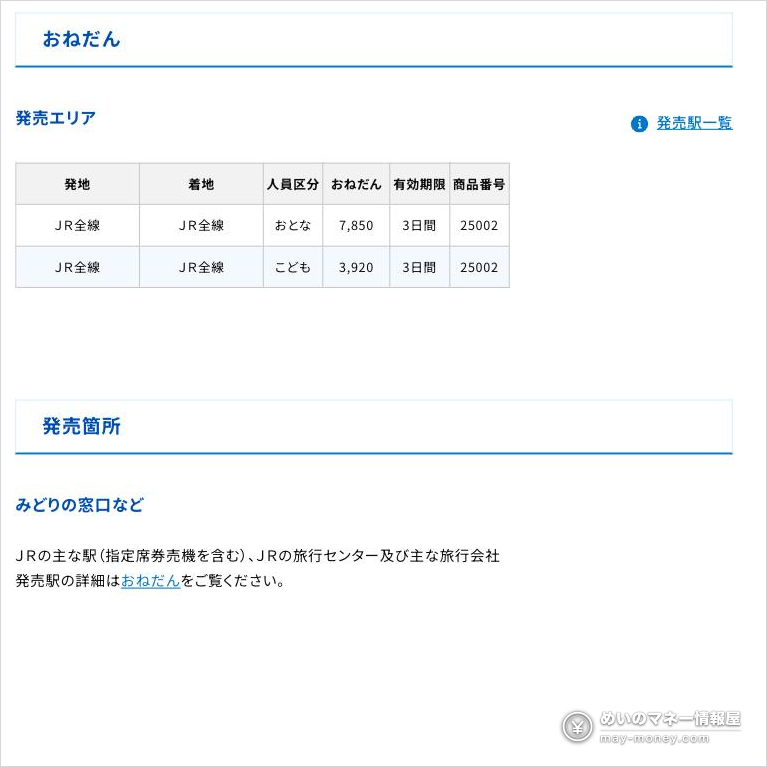
Source: JR West product page for the Aki no Norihodai Pass. Captured September 12, 2026.
At a counter, this sentence is enough: 「秋の乗り放題パス、◯月◯日から使います」 (Aki no norihōdai pasu, X-gatsu X-nichi kara tsukaimasu — “Autumn unlimited ride pass, starting from the Xth”). The purple machines also sell it; the flow walks you through picking a start date, and they have an English mode.
Both the counters and the machines take credit cards (the machines ask for your PIN). One counter-intuitive detail: buying tickets at a Midori no Madoguchi counter or a station machine is excluded from VIEW Plus and earns only the base 0.5% (currently 1% on the gold card, which adds 0.5% for now). A View Card’s high rates apply to Eki-Net prepaid bookings and Mobile Suica top-ups — and this pass is not sold online at all. So for this particular purchase, any everyday card that pays 1% or better beats the View Card.
If your trip also involves a Shinkansen or limited express leg, the savings maths changes completely. It is worth checking JRE BANK, which hands out 40%-off Shinkansen vouchers, JRE POINT for turning points into tickets, and Toku-da-ne Special 28, which halves Shinkansen fares before you settle on a route.
Does it pay for itself? ¥2,617 a day
¥7,850 divided by three comes to about ¥2,617 a day. Flip that around and the break-even is simple: any round trip where one leg costs more than ¥1,309 pays for that day on its own.
Here is what the long hauls actually cost if you ride only local and rapid trains.
| Route | One-way fare | Journey time | Share of the pass |
|---|---|---|---|
| Tokyo → Osaka (via the Tōkaidō Main Line) | ¥9,020 | 9 hr 30 min | One leg beats the whole pass |
| Tokyo → Sendai (via the Jōban Line) | ¥6,600 | 7 hr 39 min | About 2.5 days’ worth |
| Tokyo → Nagoya (via the Tōkaidō Main Line) | ¥6,490 | 6 hr 1 min | About 2.5 days’ worth |
| Osaka → Hiroshima (via the Sanyō Main Line) | ¥5,720 | 6 hr 12 min | About 2.2 days’ worth |
Fares and times checked on September 12, 2026 using Jorudan’s Seishun 18 route search, for adult one-way travel on conventional lines. Note that JR East raised fares on March 14, 2026 and now treats the Tōkaidō conventional line and the Tōkaidō Shinkansen as separate routes, so the same city pair can cost different amounts depending on which one you take. Go by the figure shown when you buy.
Ride Tokyo to Osaka once and you have already used ¥1,170 more than the pass cost. So the simplest plan wins: cover the distance on day one, spend day two where you landed, come back on day three. Even with zero train travel on the middle day, three days still put you comfortably ahead.
Versus the Seishun 18 Ticket
In October there is nothing to weigh up, because the other two passes simply are not on sale.
| Aki no Norihodai Pass | Seishun 18 Ticket (3-day) | Hokkaido & East Japan Pass | |
|---|---|---|---|
| Adult | ¥7,850 | ¥10,000 | ¥11,780 |
| Child | ¥3,920 | None — children pay full price | ¥5,890 |
| Length | 3 consecutive days | 3 consecutive days (5-day version ¥12,050) | 7 consecutive days |
| Per day | About ¥2,617 | About ¥3,333 | About ¥1,683 |
| Coverage | All JR lines nationwide | All JR lines nationwide | JR Hokkaido and JR East, plus some third-sector lines |
| Available in October? | ✓ Oct 3–18 | ✗ Summer ended Sept 8, winter starts Dec 11 | ✗ Summer ended Sept 30, winter starts Dec 11 |
A few differences are worth holding on to:
- It undercuts the three-day Seishun 18 Ticket by ¥2,150 while working almost identically — both run on consecutive days and both go through automatic ticket gates.
- Only this one has a child fare. One adult plus one primary-school child comes to ¥11,770 here against ¥20,000 on Seishun 18 — a ¥8,230 gap. For families this is the best window of the year.
- The Hokkaido & East Japan Pass has the lowest daily rate, but you have to ride seven days straight to get there, and it only covers JR East and JR Hokkaido.
- Seishun 18 season means school holidays and packed carriages. October is calm, and it is the start of the autumn colours — the same slow-train trip feels like a different hobby.
Crossing to Hokkaido: the option ticket
Only the Shinkansen runs through the Seikan Tunnel — there is no local train. To reach Hokkaido on this pass you have to add the Aki no Norihodai Pass Hokkaido Shinkansen Option Ticket.
| Price | ¥4,650 adult / ¥2,320 child |
|---|---|
| On sale | September 18 – October 18, 2026 (through the last day the main pass is valid) |
| Valid | October 3 – 18, 2026 |
| Covers | Any empty ordinary-car seat on the Hokkaido Shinkansen between Shin-Aomori and Kikonai, plus the Dōnan Isaribi Railway between Kikonai and Goryōkaku — one way, once |
| Format | Two coupons: one for the Shinkansen, one for the Dōnan Isaribi Railway |
| At the gate | The Shinkansen leg works with automatic gates (feed it in together with the main pass). On the Isaribi line, show both to staff. |
Run the numbers and buying the legs separately would cost ¥2,530 base fare plus ¥2,850 for the non-reserved-equivalent express charge between Shin-Aomori and Kikonai, then ¥1,080 for Kikonai to Goryōkaku — ¥6,460 in total. The option ticket is ¥4,650, so you save ¥1,810. Not dramatic, but there is no other way across the strait, so if Hokkaido is on the itinerary the decision makes itself.
- It does nothing on its own. It only works alongside a valid Aki no Norihodai Pass, and once you start using it, nobody else may use it — no lending, no transferring.
- Both ends are fixed. The Shinkansen leg has to run the full Shin-Aomori–Kikonai stretch; you cannot join partway (Kikonai aside).
- Break the journey on the Isaribi line and you pay the whole line’s fare. Kikonai is the only station where you may get off. And if you stay on the Shinkansen past Kikonai to Shin-Hakodate-Hokuto, you owe the fare and surcharge for the entire Shinkansen journey.
- “Empty seat” is not a reservation. If you want a seat assigned, or a Green Car or Gran Class seat, you need a base fare ticket on top of the express and Green Car tickets.
Planning the three days
October 12, 2026 is Sports Day, so Saturday the 10th, Sunday the 11th and Monday the 12th form a three-day weekend that lines up exactly with the pass. The trade-off is that these are the busiest three days of the whole run. With a sixteen-day window there is plenty of room to shift onto weekdays if you would rather have the space.
Three principles for building the itinerary:
- Go furthest on day one, drift back on day three. Local trains are slow, so load the distance onto the bookends and give the middle day entirely to wherever you landed.
- Don’t be a purist about it. Flying or taking the Shinkansen out and using the pass only on the way back, stopping where you like, often works out better on both time and money. The same goes in reverse: buying a short limited-express ticket to skip one tedious stretch is a perfectly sensible move.
- Put the scenic lines in daylight. Mid-to-late October is when the Tadami and Gonō lines start turning, and on those routes the window is the destination. Ride them after dark and you have simply sat on a train.
By region, the usual shapes are:
- From Kantō — north through Tokyo, Sendai and Morioka, or west down the Tōkaidō towards Kansai. Upgrading the commuter-line stretches to a Green Car seat changes how the day ends.
- From Kansai — Osaka to Okayama to Hiroshima, finishing on the Miyajima ferry. The crossing itself is included, so the island costs you the ¥100 visitor tax and nothing else. This is the route that shows off what the pass is for.
- On to Hokkaido — add the option ticket and cross from Aomori to Hakodate. It is good for one direction only, so a return trip means buying two.
Eight things that trip people up
- No skipping days. Three consecutive days means a gap day is a wasted day.
- No sharing. One pass, one person — and you cannot buy a single pass for two children.
- October 16 is the last day to buy, not the last day to travel. Sales run only through passes starting on October 16, so the final possible window is October 16–18.
- You get one change of start date, and only while unused. Once you have travelled on it, the date is locked.
- Refunds only while unused, and there is a ¥220 fee. After you start using it, cancellations and delays bring neither a refund nor an extension.
- It does not combine with other discount tickets. That covers discount certificates and other special-offer passes; the Hokkaido Shinkansen option ticket is the single exception.
- Lose it and you buy another. Even if the original turns up later, there is no refund.
- The last day runs to the last train. If there is all-night running that night, the pass still stops at the final train on the normal timetable.
FAQ
- Q. Can foreign residents buy this pass?
- A. Yes. There is no restriction on age, nationality or residence status, and no passport or residence card is checked. This is unlike the nationwide Japan Rail Pass, which only people entering Japan on Temporary Visitor status may buy or use.
- Q. Can I use the three days separately?
- A. No. The three days run consecutively from the start date you choose at purchase, and skipping a day is not allowed.
- Q. Can two of us take turns with one pass?
- A. No. The announcement states that one pass is for one person, and that you cannot buy a single pass for two children.
- Q. Can I ride a limited express if I buy the express ticket separately?
- A. No. The pass does not count as a base fare ticket on a limited express, so you would have to buy both the base fare and the express ticket. The only exceptions are five sections: Sekishō Line (Shintoku–Shin-Yūbari), Muroran Main Line (Higashi-Muroran–Muroran), Ōu Main Line (Shin-Aomori–Aomori), Sasebo Line (Haiki–Sasebo) and Miyazaki Airport Line (Miyazaki Airport–Miyazaki).
- Q. What about the Green Car?
- A. Non-reserved Green Car seats on local and rapid trains are fine with a Green Car ticket on top — that includes the commuter Green Cars around Tokyo. Reserved Green Car seats, such as on the Marine Liner rapid, are not covered, and need a separate base fare ticket as well as the Green Car ticket.
- Q. Can I buy it online?
- A. No. The listed sales points are major JR stations (including the reserved-seat ticket machines), JR travel centres and major travel agencies. You have to buy it in person.
- Q. Can I get a refund if I never use it?
- A. Yes, as long as it is completely unused and you are before or within the validity period. A ¥220 fee is deducted per pass. Once you have started using it, there is no refund for cancelled or delayed trains.
- Q. Is the Seishun 18 Ticket available in October?
- A. No. In 2026 the summer edition ran to September 8 and the winter edition starts December 11, leaving October empty. The Hokkaido & East Japan Pass has no October run either.
- Q. Is the Miyajima ferry really free?
- A. The JR West Miyajima ferry fare, normally ¥200 each way, is included and you can ride as often as you like. The ¥100 Miyajima visitor tax charged when you land on the island is not included and is paid separately.
Sources
- JR Group, “Sale of the Aki no Norihodai Pass and the Aki no Norihodai Pass Hokkaido Shinkansen Option Ticket” (August 31, 2026) — JR West newsroom (prices, dates and the Appendix 1 rules)
- JR West product page: Aki no Norihodai Pass (sales points, treatment of non-reserved Green Car, reserved ordinary seats and boarding-order tickets, change and refund details)
- JR West product page: Hokkaido Shinkansen Option Ticket
- JAPAN RAIL PASS — eligibility for use (Temporary Visitor status requirement)
- View Card, “VIEW Plus” (ticket purchases at counters and machines fall outside VIEW Plus at 0.5%)
- Dōnan Isaribi Railway fare table (Goryōkaku–Kikonai, ¥1,080 adult)
- Local-train fares and journey times: Jorudan Seishun 18 route search, checked September 12, 2026
- 2026 sale and validity periods and prices for the Seishun 18 Ticket and the Hokkaido & East Japan Pass: company announcements and Seishun 18 Kippu Kenkyūjo
Based on information published as of September 12, 2026. Fares and rules change, so check the JR companies’ own pages before you buy.
As above, a View Card earns nothing extra at a station counter or machine, which means an everyday card paying 1% or more is the more useful thing to have in your wallet for this. If you do not have one yet, Rakuten Card is the easy answer — permanently free, and the sign-up bonus is topped up often. The conditions are laid out in our Rakuten Card guide.
