- The headline number didn’t change. What changed is that the ¥10,000 cap and the one-year time limit came off, so the double points now run indefinitely.
- That extra 1% does not arrive on its own. Three online setups plus your direct-debit account have to be done before the month you spend closes.
- Utilities, taxes and e-money top-ups do not earn 2% — they land at roughly 0.4% or nothing at all.
- The billing account can only be a Mizuho ordinary account. If you don’t want to open one, this card isn’t an option.
- What actually changed
- Where the 2% (and the 4%) comes from
- The spending that won’t earn 2%
- Four things you have to set up
- Fund investing through Rakuten Securities
- What Mizuho Points are worth, and when they expire
- How it compares with Olive and MUFG
- The autumn campaign: up to ¥50,000, plus a referral code
- Who it suits, and who should pass
- How to apply, and the full spec
- Questions people ask
What actually changed
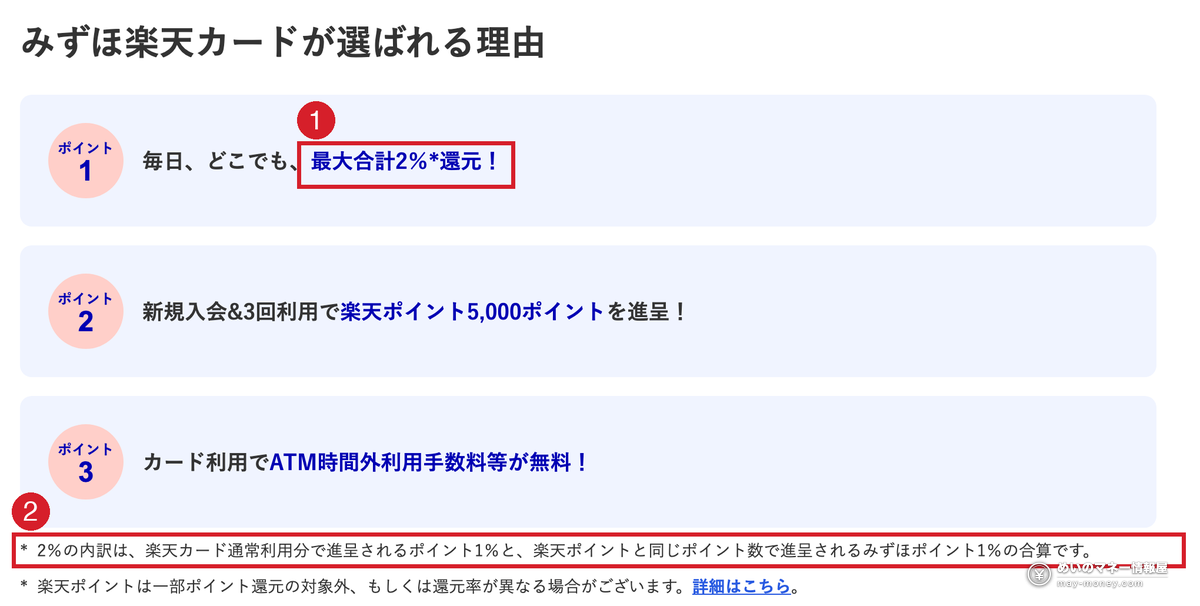
On 7 September 2026 Mizuho Bank launched a new retail strategy called Nattoku! Mizuho, and the most concrete piece of it is a rework of the points on the Mizuho Rakuten Card (みずほ楽天カード), which the bank has issued since December 2024. Every purchase that earns Rakuten Points now earns the same number of Mizuho Points on top — up to 2% combined, with no annual fee.
Worth being precise here, because a lot of the coverage isn’t: the double-points mechanic already existed. The rate did not go from 1% to 2%. What went away are the two limits that used to sit on it.
| Old scheme (W Point Plan) | New scheme (Double Point) | |
|---|---|---|
| Combined rate | Up to 2% (1% Rakuten + 1% Mizuho) | Up to 2% (same split) |
| Cap on Mizuho Points | Stopped at ¥10,000 worth | No cap |
| Time limit | One year maximum | Runs indefinitely |
| Annual fee | None | None (unchanged) |
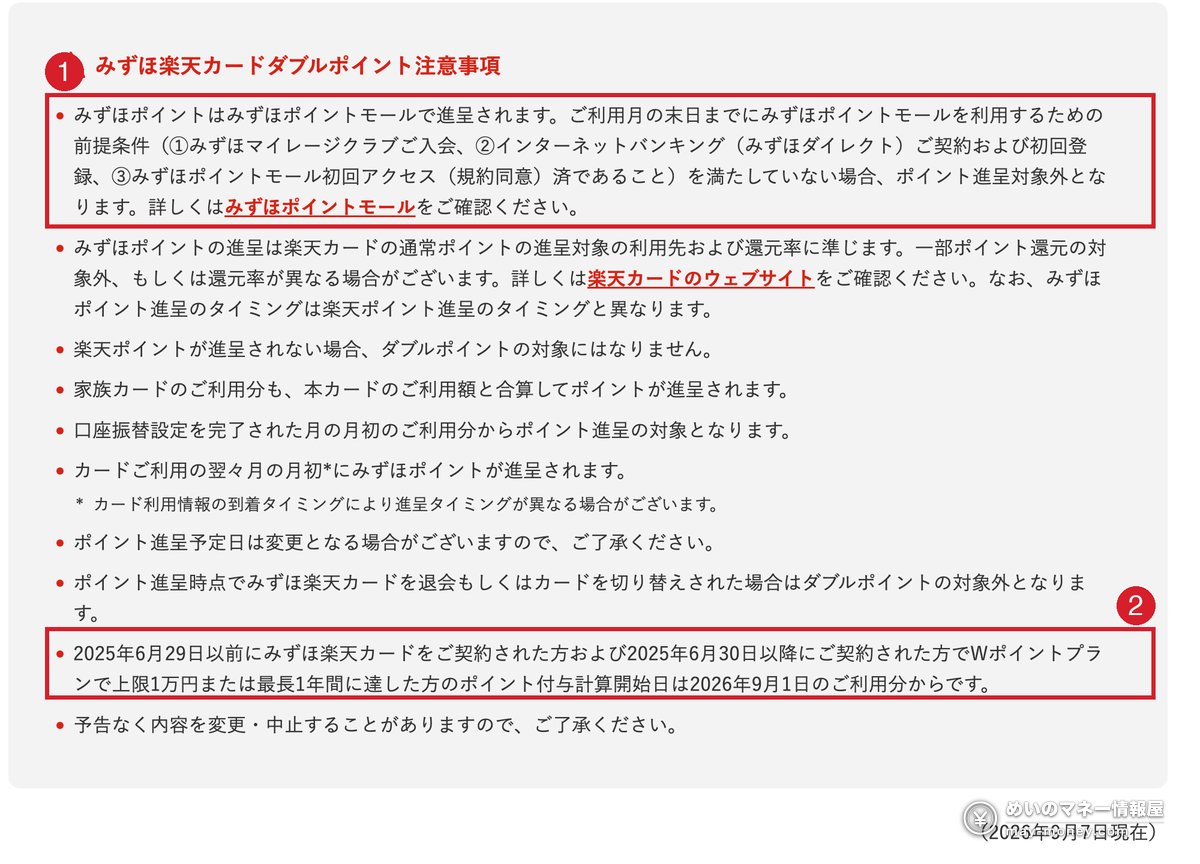
The terms spell out the date. If you signed up on or before 29 June 2025, or signed up later but already hit the ¥10,000 cap or the one-year limit under the old plan, your points are calculated under the new scheme from spending on 1 September 2026 onwards. No new application needed.
Source: Mizuho Bank, “Mizuho Rakuten Card” (page dated 7 September 2026)
Where the 2% (and the 4%) comes from
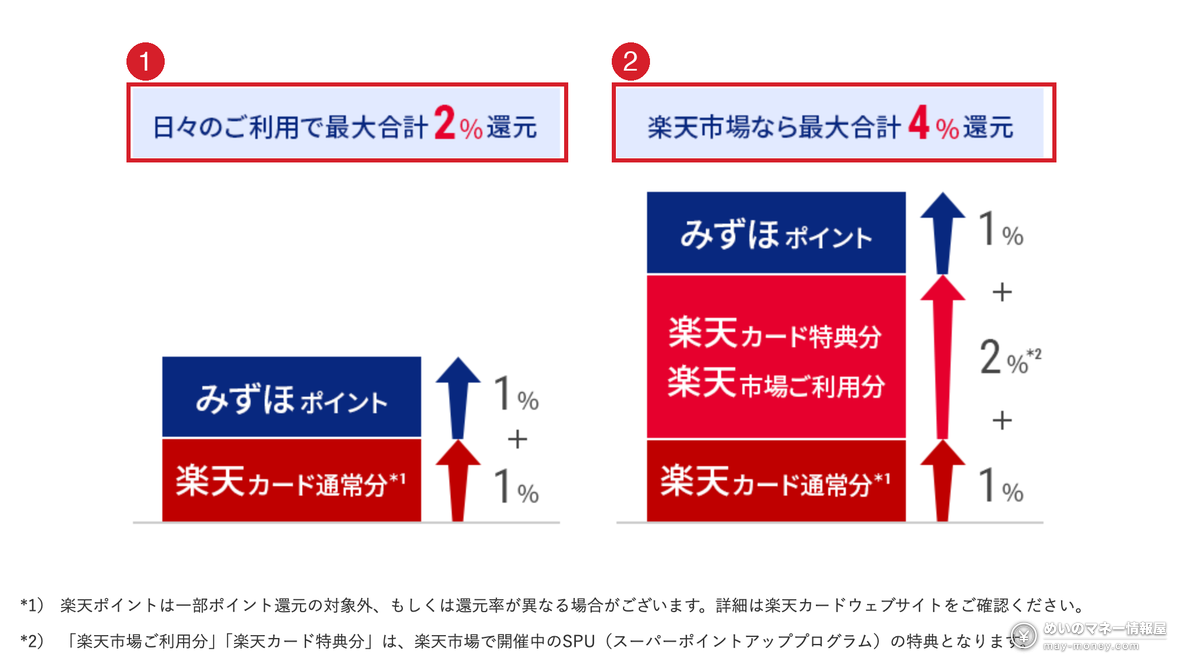
Two numbers get quoted, so it’s worth separating them: 2% on everyday spending, up to 4% on Rakuten Ichiba. Mizuho’s own diagram lays it out cleanly.
Source: Mizuho Bank, “Mizuho Rakuten Card”
The extra layer is always Mizuho Points — a separate currency from Rakuten Points, credited on a different schedule. The 2% inside the Ichiba figure comes from SPU, Rakuten’s stacking programme, and the card bonus portion of that is capped at 1,000 points a month on a standard Rakuten Card. The parts with no ceiling are the base 1% and the Mizuho 1%.
The terms are explicit: Mizuho Points follow the same eligible merchants and the same rates as standard Rakuten Card points. So anything Rakuten already excludes is excluded from the doubling as well — the two move together.
The spending that won’t earn 2%
This is where expectations usually break. Rakuten pays only 1 point per ¥500 on utilities and taxes, and nothing at all on e-money top-ups — and the doubling inherits those rates.
| What you’re paying for | Rakuten Points | Mizuho Points | Combined |
|---|---|---|---|
| Everyday shopping, dining, online orders | 1 pt per ¥100 (1%) | Same (1%) | 2% |
| Electricity, gas, water National and local taxes, pension, NHK | 1 pt per ¥500 (0.2%) | Same (0.2%) | About 0.4% |
| Top-ups to Mobile Suica, au PAY, WAON, nanaco, FamiPay, Mobile ICOCA / PASMO | Not eligible | None | 0% |
| Annual fees, service charges, cash advances, donations | Not eligible | None | 0% |
Push all your fixed costs onto this card and the utility and tax slice quietly drops to around 0.4%. Leave those on whatever pays better and keep this card for ordinary purchases — that’s where the 2% actually does its work. And if your plan involved routing spending through e-money top-ups, this card simply isn’t built for it.
Four things you have to set up
The extra 1% is not automatic. Mizuho requires three prerequisites to be in place by the last day of the month you spend in, and the direct-debit setup makes four. Miss any of them and that month pays 1%, not 2%.
みずほマイレージクラブ. Free membership, and also the gateway to the ATM fee waivers.
みずほダイレクト, the online banking service. Signing the contract isn’t enough — the first login counts as part of the step.
みずほポイントモール is where the points are issued. Skip it and there is nowhere for them to land.
Eligibility starts from the first day of the month you complete it. Earlier months are not backdated.
Source: Mizuho Bank, “Notes on Mizuho Rakuten Card Double Points” (page dated 7 September 2026)
A few timing details that catch people out:
- Mizuho Points land at the start of the second month after you spend, on a different schedule from Rakuten Points. Seeing nothing for the first couple of months is normal, not a fault.
- Family card spending is pooled with the main cardholder’s.
- Cancel or switch the card before the points are issued and you lose them. Check what’s still in flight before you close anything.
Fund investing through Rakuten Securities
The card also works for kureka tsumitate (クレカ積立) — buying mutual funds monthly by credit card through Rakuten Securities — and the doubling applies there as well. Rakuten Securities sorts cards into four tiers; the Mizuho Rakuten Card sits in the “any other Rakuten Card” tier, with matching Mizuho Points stacked on top.
| Fund’s agency fee (代行手数料) | Rakuten Points | Mizuho Points | Combined |
|---|---|---|---|
| 0.4% a year or more (incl. tax) | 1% | 1% | 2% |
| Under 0.4% a year (incl. tax) | 0.5% | 0.5% | 1% |
The awkward part is that the rate is decided using a date in the past. For ordinary funds, Rakuten Securities looks at the agency fee as of the 12th of the month before your purchase (the previous business day if that falls on a holiday); for variable-fee funds, it uses the 13th, three months earlier. The same fund can therefore drift between 1% and 2%, and the broker states outright that the rate at setup and the rate at purchase may differ.
Cheaper funds carry lower agency fees, which puts them under 0.4% and therefore at 1% combined. The 2% tier is mostly higher-fee active and leveraged products. The expense ratio gap will cost you more than the extra 1% earns, so this is not a reason to change what you buy. Rakuten Securities publishes the full eligible-fund list as a PDF. If you want to treat the monthly purchase itself as a points engine, that’s covered in buy-and-sell fund points farming.
One footnote: the Rakuten Securities landing page for this card still describes the old scheme, cap and all. That cap came off on 7 September — Mizuho’s own page is the current one.
What Mizuho Points are worth, and when they expire
A fair worry with any bank-issued currency is that it only spends inside the bank’s own mall. That isn’t the case here.
| Exchange into | Rate | Notes |
|---|---|---|
| Rakuten Points | 1:1 | Mizuho calls it an equal-value exchange. The simplest route if you already live in the Rakuten ecosystem. |
| PayPay Points | 1 pt ≈ ¥1 | Cannot be withdrawn or transferred. Usable in the PayPay and PayPay Card official stores. |
| Amazon gift cards and other digital gifts | 1 pt ≈ ¥1 | One of the examples Mizuho lists; the catalogue runs wider. |
| d POINT and other shared programmes | 1 pt ≈ ¥1 | Mizuho’s FAQ names Rakuten, PayPay and d POINT as the shared-point options. |
Once they’re Rakuten Points, the classic ways to spend them well are Welcia Day and the nanaco route.
They expire after two years. The autumn campaign terms put it precisely: usable until 23:59 on the last day of the month, 24 months after they were issued. No rush, but long enough to forget about.
How it compares with Olive and MUFG
For a long time the going rate on a no-fee card in Japan has been about 1% — Rakuten Card at 1%, Recruit Card at 1.2%. 2% with no merchant restrictions, no campaign registration and no cap is genuinely unusual in that bracket.
But the other megabanks are playing a different game, so comparing headline percentages alone will mislead you.
| Card | Shape of the reward | What that means |
|---|---|---|
| Mizuho Rakuten Card | 2% everywhere, all the time (up to 4% on Rakuten Ichiba) | No cap, no end date. The price is a Mizuho billing account and three setup steps. |
| SMBC Olive Flexible Pay | Up to 8% at selected convenience stores and restaurants, paying by phone | Higher ceiling, narrow doorway. Step outside the list and you’re back to the base rate. |
| MUFG Card | Up to 20% at selected merchants once conditions are met | The biggest number and the longest condition list. Your actual return depends on how many you clear. |
We’ve covered SMBC’s side in the Olive account guide, and all three banks side by side in the megabank comparison. Put simply: the others spike in specific shops, Mizuho pays the same everywhere. If your spending is spread across supermarkets, drugstores, online orders and subscriptions, a steady 2% beats 8% that only fires at convenience stores. If nearly all of it happens at konbini and chain restaurants, 2% may not be your best answer.
Sign-up bonuses are a separate contest entirely. Fee-paying cards run referral offers in the six-figure point range, which is a different order of magnitude — see Amex Gold Preferred (up to 170,000 points) or Marriott Bonvoy Amex Premium. These aren’t mutually exclusive: put daily spending on the 2% card and chase bonuses separately.
Some context for why Mizuho is doing this. Personal deposits sit at roughly ¥48 trillion at Mizuho, ¥62 trillion at SMBC and ¥87 trillion at MUFG. Mizuho is the one playing catch-up in retail, and it is buying accounts with a cashback rate — which is also why the billing account is locked to Mizuho.
And within the Rakuten lineup itself?
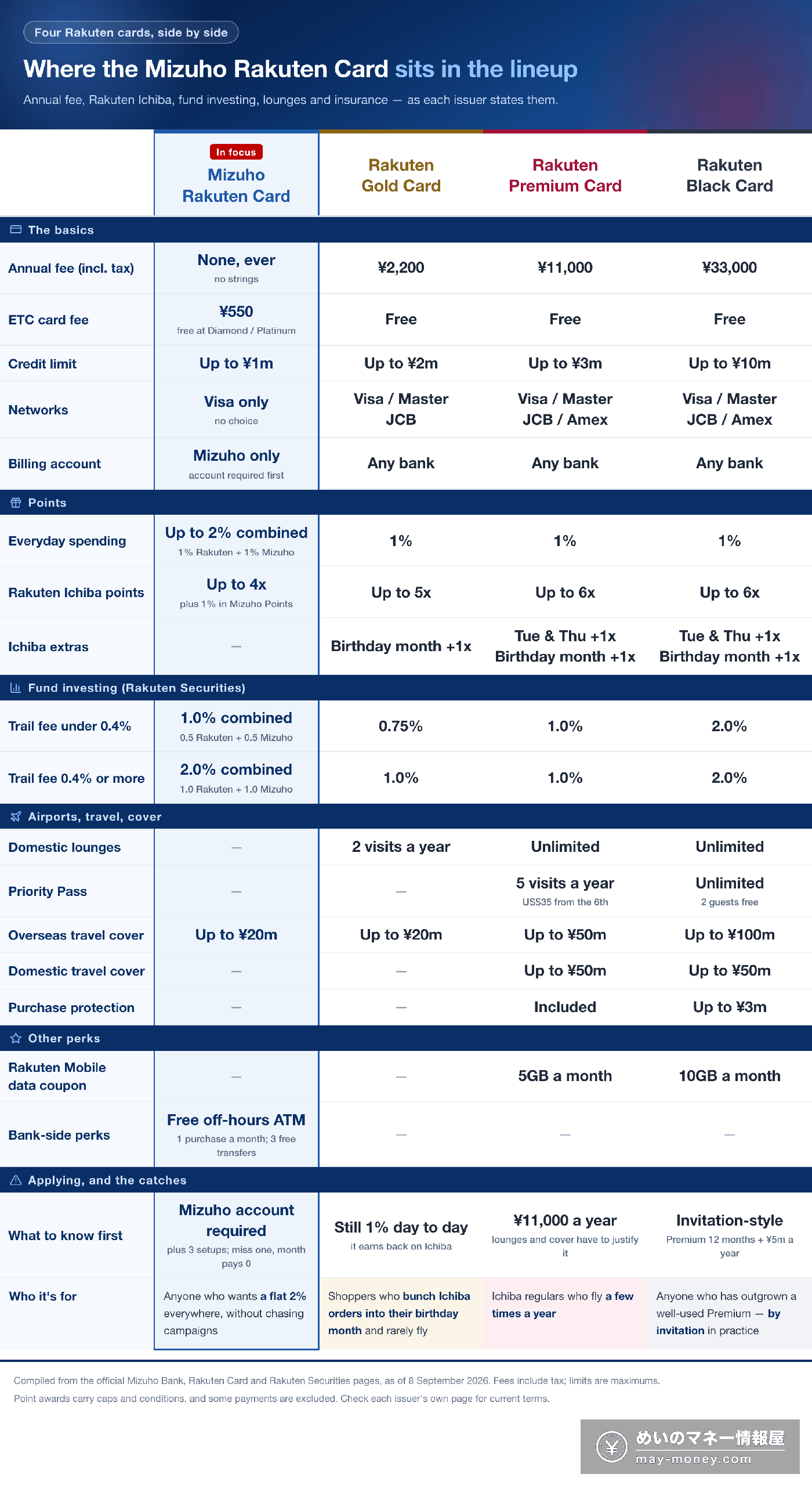
The other question that keeps coming up: where does it sit among Rakuten’s own cards? Put it on the same ruler as the Gold, Premium and Black and the division of labour is easy to see.
Source: compiled from the official Mizuho Bank, Rakuten Card and Rakuten Securities pages (as of 8 September 2026)
The autumn campaign: up to ¥50,000, plus a referral code
Running alongside all this is the Aki-Toku Campaign (秋トク!キャンペーン), 7 September to 12 November 2026. Mizuho’s headline is “up to ¥50,000 in value for opening an account and meeting the conditions” — up to 45,000 Mizuho Points plus up to 5,000 Rakuten Points. It’s three separate offers, and the card is only one of them.
| Offer | Value | Main conditions |
|---|---|---|
| Offer 1 Open a new account | Mizuho Points up to ¥30,000 | Balance of ¥100,000 → 10,000 pts, ¥300,000 → 30,000 pts (one or the other). You must hold the balance at 24:00 on all three of 29 Dec 2026, 31 Jan 2027 and 28 Feb 2027. |
| Offer 2 New account + this card | up to ¥15,000 (10,000 Mizuho + up to 5,000 Rakuten) | Open an account and apply for the Mizuho Rakuten Card, then use it. This is the one covered below. |
| Offer 3 Salary deposit | Mizuho Points ¥5,000 | Designate the account for salary and receive ¥100,000 or more in one go. Existing account holders qualify for this one — Mizuho says so explicitly. |
Offer 2 splits into two payouts run by two different companies, with separate conditions:
| Payout | Points | Main conditions | Window |
|---|---|---|---|
| Rakuten Points (run by Rakuten Card) | Up to 5,000 (2,000 sign-up + 3,000 usage) | New cardholder. Three or more purchases of ¥1+ by the end of the month after you apply. Direct debit set by the 25th of the second month after you apply | Always running |
| Mizuho Points (Mizuho’s Aki-Toku) | 10,000 | As of 6 Sept 2026 you must not have a Mizuho ordinary account and must not hold two or more Rakuten Cards. Open account, apply, use once, set direct debit, and register | 7 Sept – 12 Nov 2026 |
The 10,000-point side is the one with the fiddly dates, so here they are in order:
- Account and card application: apply between 7 Sept and 12 Nov 2026. If you open the account online or through the app, both the account and the card also need to be issued by 19 November.
- Use the card: at least once, ¥1 or more, by the end of the month after you apply.
- Set the direct debit: by the 25th of the second month after you apply, pointing at the new Mizuho account.
- Register for the campaign: by 30 November 2026, through the banner inside Mizuho Point Mall in the Mizuho app — or the designated form if the banner doesn’t show. Skip this and the whole thing pays nothing.
- Same deadline for the receiving conditions: by 30 November you also need Mileage Club membership, a Mizuho Direct contract with first login done, and the Point Mall terms accepted.
Offer 2 requires that you had no Mizuho ordinary account as of 6 September 2026, so existing customers are out. What you can still take is the Rakuten side, Offer 3’s ¥5,000 (Mizuho states existing account holders are eligible), and the 2% itself, which starts automatically from 1 September spending.
One practical warning: when you register an account in the app for the first time, the “P” icon that leads into Point Mall takes two to three business days to appear. Leave this to the last week and you’ll run out of runway.
The standing referral programme stacks on top
Separate from Aki-Toku, Mizuho runs an ongoing account-referral scheme. An existing customer shares a referral code, and both sides receive 1,000 Mizuho Points. It has been running since 14 July 2025 with no announced end date.
| Details | |
|---|---|
| Reward | 1,000 points each to the referrer and the new customer, with no lottery element |
| Who qualifies | People who had no Mizuho ordinary account as of 13 July 2025 and opened one for the first time on or after 14 July 2025 |
| Registration deadline | End of the month after your account opening completes. Enter the code in the designated form; you’re done when the confirmation email arrives |
| To actually receive it | Mileage Club membership and a Mizuho Direct contract with first login, by the end of the month after opening |
| When it lands | Three months after the account opening completes (scheduled) |
The wording is strict on this point: if the referrer hasn’t already viewed their own referral code in the Mizuho app before you open your account, the referral doesn’t count. Hunting for a code afterwards is too late. Mine was generated well in advance, so once your account is open you can put it straight into the form:
M226684478
Reading both sets of terms as they stood on 7 September 2026, neither one excludes the other, and the actions don’t collide — one registration happens in the app, the other through a separate form. Both target newly opened accounts. That said, both also reserve the right to change or end without notice, so the official pages on the day you apply are what count.
Who it suits, and who should pass
- You already bank with Mizuho and your salary lands there. The setup cost is close to zero.
- Your spending is spread out and you’d rather not pick shops to chase a multiplier.
- You hold one Rakuten Card already and want a second for daily use — this can be that second card.
- You were about to open a new bank account anyway. The autumn offers are live right now.
- You don’t want a Mizuho account. The billing account can’t be anything else.
- You won’t do the admin. Without the three prerequisites the extra 1% pays nothing.
- You need JCB or Mastercard. Visa is the only option.
- You want a combined cash card. There’s no cash card function.
- You need a large limit. The ceiling is ¥1,000,000.
- You already hold two Rakuten Cards. You can’t add a third.
- Your goal is paying utilities, taxes or topping up e-money. That’s the 0.4% and 0% column.

How to apply, and the full spec
- Have a Mizuho ordinary account ready. If you don’t, open one first — branch, web or the account-opening app all work. Our Mizuho Bank guide covers the paperwork. Business-purpose personal accounts can’t be used for billing.
- Apply from Mizuho’s own page. Use “first application” if this is your first Rakuten Card, or “second card” if you already hold one. Rakuten Card Co. runs the screening and posts the card.
- Join Mizuho Mileage Club, sign up for Mizuho Direct and complete the first login. This is the foundation for the extra 1%, so do it early.
- Open Mizuho Point Mall and accept the terms. Tap the “P” icon at the top of the Mizuho app’s home screen. Right after registering a new account it takes two to three business days to appear.
- Set the direct-debit account. The 2% eligibility window opens on the first day of the month you complete this.
- If you’re going for the 10,000 points, register by 30 November. You’re only done when the confirmation email arrives.
| Details | |
|---|---|
| Annual fee | None, permanently |
| Reward rate | Up to 2% combined (per ¥100: 1 Rakuten Point + 1 Mizuho Point) |
| Network | Visa only |
| Billing account | Mizuho Bank ordinary accounts only |
| Credit limit | Up to ¥1,000,000 |
| Built in | Rakuten Point Card; Rakuten Edy optional (¥330 incl. tax issuing fee). No cash card function |
| ETC card | ¥550 a year (incl. tax); free for Rakuten Diamond and Platinum members |
| Also included | Family cards, card theft insurance, overseas travel accident insurance (conditions apply), cash advances |
| Banking perks | Use the card once a month to qualify for Mizuho Mileage Club’s “Ureshii Tokuten”: out-of-hours ATM fees waived at Mizuho and AEON Bank ATMs, E-net ATM usage and out-of-hours fees free up to three times a month, and three free transfers a month to other banks via Mizuho Direct |
| Eligibility | Residents of Japan aged 18 to 89 at the time of application |
With one card in hand, you can apply for the Mizuho Rakuten Card as your second. Points from both go into the same Rakuten Point account.
With two, you can’t. Rakuten caps you at two cards at a time, and the official terms say applications are refused in that case. To switch, cancel one first and wait for the cancellation to complete before applying. The same applies if your first card is a Rakuten Bank Card, Rakuten ANA Mileage Club Card or Rakuten Card Academy.
Before cancelling anything, check points still in flight (anything unissued at the time you close the account is forfeited) and any recurring payments tied to that card.
Questions people ask
- Q. I already have the card. Do I need to reapply to get 2%?
- No. The official notes state that holders who signed up on or before 29 June 2025, and those who signed up later but exhausted the old plan’s cap or one-year limit, switch to the new calculation from spending on 1 September 2026. You do need the three setups and the direct-debit account already in place.
- Q. Is there a monthly or annual cap on the 2%?
- No. Removing the old ¥10,000 cap and one-year limit is the whole point of this revision. The one ceiling that remains is inside the 4% Rakuten Ichiba figure: the card bonus portion comes from SPU and is capped at 1,000 points a month on a standard Rakuten Card.
- Q. When do Mizuho Points arrive?
- At the start of the second month after you spend, on a different schedule from Rakuten Points. Mizuho notes that timing can shift depending on when merchants submit the transaction.
- Q. Can I get this card without a Mizuho account?
- No. Billing is restricted to Mizuho ordinary accounts (business-purpose personal accounts excluded), so the account comes first. If you’re opening one now, the autumn campaign offers are available at the same time.
- Q. Do Mizuho Points expire?
- Yes, after two years — usable until 23:59 on the last day of the month, 24 months after issue. They convert at 1 point ≈ ¥1 into Rakuten Points (equal value), PayPay Points, d POINT, Amazon gift cards and more.
- Q. How much do I earn on Rakuten Securities fund purchases?
- It depends on the fund’s agency fee. Funds at 0.4% a year or more (incl. tax) earn 1% Rakuten plus 1% Mizuho, so 2% combined; funds under 0.4% earn 0.5% plus 0.5%, so 1%. The rate is fixed using the agency fee as of the 12th of the previous month (the 13th, three months earlier, for variable-fee funds), so the same fund can move between 1% and 2%. Low-cost index funds usually sit at 1%.
- Q. I already hold two Rakuten Cards. Can I apply?
- No. Rakuten allows two cards at a time and the official terms exclude applicants who already hold two. If you want to switch, cancel one and wait for the cancellation to complete before applying. Check for unissued points and recurring payments on that card first.
- Q. When do I enter the referral code?
- After your Mizuho account is open. Go to the designated entry form, submit the code with your details, and wait for the confirmation email — that’s what completes it. The deadline is the end of the month after your account opening completes. Note that the referrer must have viewed their code in the app before you opened the account. Points are scheduled to land three months after opening.
- Q. How much better is this than a plain Rakuten Card day to day?
- On the same ¥100 purchase, a standard Rakuten Card gives 1 point; this one gives 1 Rakuten Point plus 1 Mizuho Point. At ¥100,000 a month, or ¥1.2 million a year, the gap is roughly 12,000 points annually — assuming the three setups are done and the spending is eligible for standard Rakuten Card points.
・Mizuho Bank — Mizuho Rakuten Card (rate breakdown, Double Point notes, card spec, Ureshii Tokuten)
・Mizuho Bank — Aki-Toku Campaign (the three offers, values and conditions, balance assessment dates)
・Mizuho Bank — Referral Programme (conditions, registration deadline, payout timing)
・Rakuten Card — Mizuho Rakuten Card (sign-up bonus, Aki-Toku conditions and window, Mizuho Point expiry)
・Rakuten Card — merchants with different point rates (¥500 per point on utilities, e-money top-up exclusions)
・Rakuten Securities — reward rates for card-funded fund purchases (rates and assessment dates)
・Asahi Shimbun (megabank personal deposit balances) / Reuters (removal of the cap and time limit) / Impress Watch, ASCII, AdverTimes (announcement details and rival reward structures)